Haverford Roofing brings more than 20 years in the trade to roofing in West Norriton, and on some houses here the first question is not which shingle to pick. It is whether the replacement, priced together with everything else planned for the house, crosses a line the township’s floodplain rules draw at half the building’s market value.
For most roofs that question never comes up. We start a leak call the same way every time: a look in the attic as well as on the roof, a straight answer on whether repair will do, and a written scope with every part of the job priced on its own line. That scope is also what makes a cost test possible to follow.
Before we price roof work in West Norriton, we check the township’s own permit rule rather than borrowing one from a neighboring township, because each one sets its own. For a house near the Schuylkill River we also ask where it sits on the flood map, since that changes what the estimate needs to show.
West Norriton’s Floodplain Conservation District Along the Schuylkill

West Norriton’s zoning ordinance handles flood areas in Part 22, titled Zoning Regulations in Floodplains. It creates a Floodplain Conservation District covering the one-percent annual chance flood areas, the Zones A and AE shown on FEMA’s flood insurance rate maps.
The Maps Behind the District
The ordinance ties the district to the Flood Insurance Study and rate maps effective March 2, 2016, in section 27-2208(1). Those maps, not a neighbor’s memory of the last high water, decide whether a lot falls inside the district. When we look at a house near the river, the 2016 map panel is where the conversation starts.
We do not guess at a property’s zone from the street. The owner, the township office or the current FEMA flood map can confirm it, and we write the answer into our notes before any scope is drafted. A house outside the district is priced as an ordinary re-roof, with none of the cost test below.
Riverview Boulevard and the Route 422 Bridge
The district is not a dormant line on a map. In 2026 the township Zoning Hearing Board listed Hearing No. 930, an application by Toll Mid-Atlantic LP for a 402-unit townhouse development on Riverview Boulevard, along the northerly banks of the Schuylkill River east of the Route 422 bridge. The parcel sits in both the Business Professional district and the Floodplain Conservation District.
The application asked for variances from the district’s rules on new structures, fill, vegetation clearing, roads, parking and stormwater, and on streets set lower than one foot below the regulatory flood elevation. We have not seen the outcome of that hearing. What it shows a homeowner is that these rules are in active use along this stretch of river today.
A Permit Before Development
Section 27-2232 says a permit shall be required before any construction or development is undertaken, and the ordinance defines development broadly as any man-made change to improved or unimproved real estate, renovation included. Whether a given roof job triggers a floodplain review is a question for the township, and we put it to the township rather than answer it ourselves.
The township’s construction permit application is reviewed by Code Inspections, Inc. and includes a contractor table with a Roofing row. The fee schedule has no separate roofing line; building permits run $50 for the first $2,000 of cost and $25 for each additional $1,000, plus a $4.50 Act 45 surcharge and a $60 administration fee.
Looking for roofing closer to East Norriton? See Roofing Services in East Norriton.
What Counts as a Substantial Improvement
Section 27-2207 defines a substantial improvement as any reconstruction, rehabilitation, addition or other improvement of a structure whose cost equals or exceeds 50% of the market value of the structure. A project at or above that line has to bring the house into full compliance with the floodplain rules, which is a very different job from the one the owner set out to do.
Any Modification of Any Kind
Section 27-2216(1)(D) repeats the point in plain terms: any modification, alteration, reconstruction or improvement of any kind to an existing structure at 50% or more of market value is a substantial improvement and must fully comply. The test is a share of the building’s value, not a fixed dollar figure, so the same roof price can land differently on two houses.
The one stated exclusion covers projects that correct identified health, sanitary or safety code violations and are the minimum necessary to do so. A roof replaced because it is worn out, or as part of a larger renovation, is not that kind of project, so we price it on the assumption that it belongs in the project total.
Substantial Damage From Any Cause
The same section defines substantial damage as damage from any cause where restoring the structure would cost 50% or more of its market value before the damage. That covers a fallen tree or a storm as much as rising water. A house that reaches that line is treated as a substantial improvement under the same definition.
After a storm we photograph the damage and write it up for the owner’s own claim, and we will meet the insurance adjuster on site when asked, without negotiating the claim. On a house inside the district, that write-up also gives the owner a record of what was damaged and what restoring it would involve.
Why Itemized Scopes Matter Here
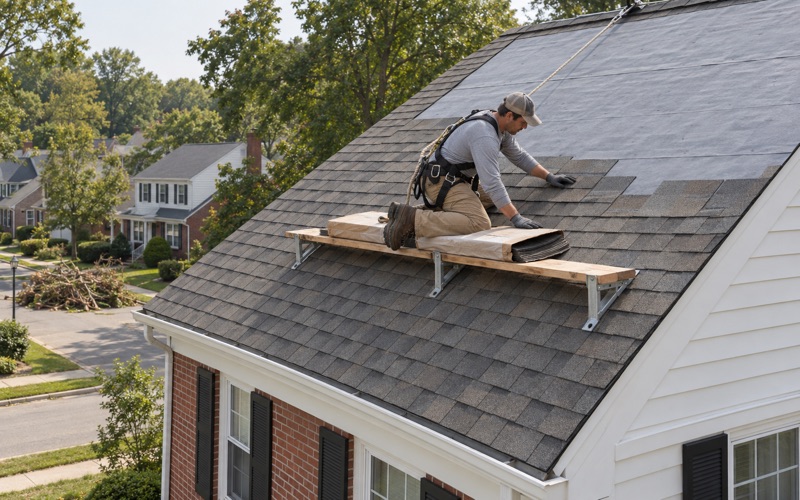
A cost test is only as clear as the numbers fed into it. Our written scopes list tear-off, decking, underlayment, flashing, ventilation and gutters as separate lines, so an owner, a floodplain administrator or a second contractor can see exactly what the roof portion of a project costs and where each dollar goes.
Damaged decking found once the old roof is off is photographed and shown to the owner before it is replaced, at a per-sheet price set in the contract. That keeps a surprise from quietly pushing a project total upward on a house where the total is the whole question.
Where a Roof Replacement Fits in the 50% Test
Where roofing fits in the 50% test is not spelled out in the ordinance text quoted above. The clearest guidance comes from substantial-improvement handouts that floodplain administrators elsewhere have based on FEMA’s P-758, and we treat it as guidance from those offices rather than as West Norriton’s own rule.
What Those Handouts Include
The handouts list reshingling or retiling a roof among the costs to include, along with roofing, gutters and downspouts as a category. They also say contractor overhead and profit belong in the figure, so the number that matters is the full contract price, not the cost of shingles and nails.
For a house in the Floodplain Conservation District, that means a re-roof combined with a kitchen remodel, an addition or interior repairs can move the combined project closer to half the structure’s market value. We give the owner the roof figure in a form that can be set beside the rest of the project’s costs.
Emergency Covering Versus Permanent Repair
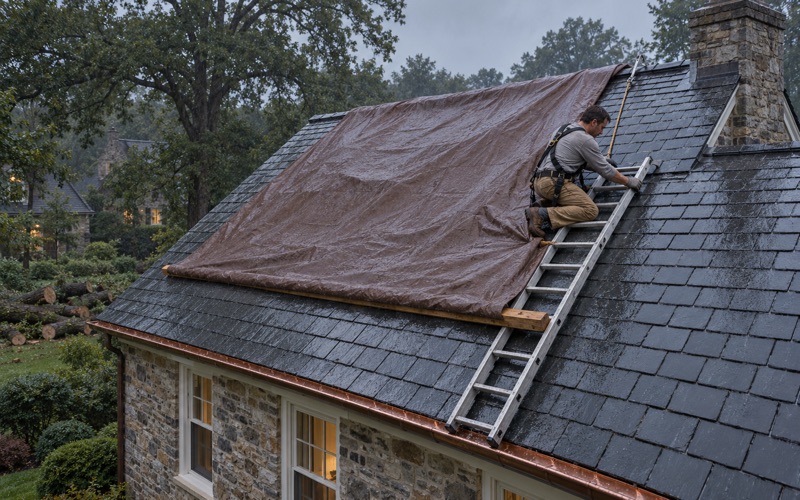
The same handouts treat covering a damaged roof as a cleanup-type activity that is not typically included in a substantial damage calculation. Permanent repair or replacement is a different matter and has to be counted. In practice, a tarp over storm damage buys time, while the shingles that follow it belong in the figure under that guidance.
We keep the two kinds of work apart on paper. Temporary protection after a storm is written up as its own item, and the permanent roof is scoped separately, so nobody has to untangle later which dollars were cleanup and which were the improvement.
Layers, Tear-Off and Flashing
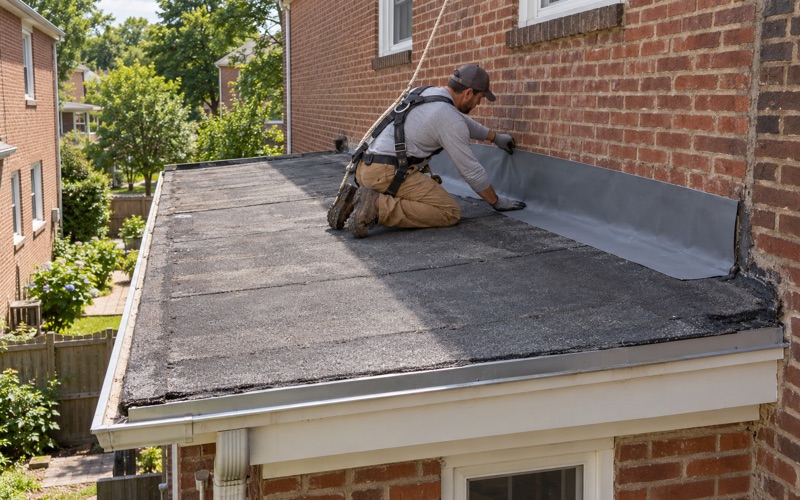
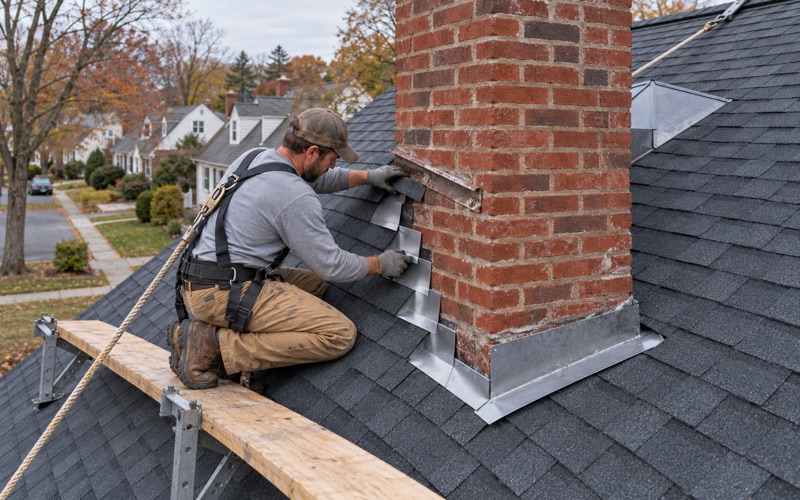
Replacing step, counter and chimney flashing with the roof rather than reusing it, and tearing off down to the decking, both add to the roof’s share of an estimate. On a house in the district we show those items plainly, so the owner knows what each one adds to the total being measured.
We do not skip flashing or cut corners to keep a number under a line. If a sound repair will do the job, we say so before replacement is ever discussed, and that honest answer can keep a modest roof project modest.
Repeat Flood Damage and Planning the Work
The ordinance adds a second trigger that has nothing to do with the size of the current job. Repetitive loss means flood-related damage sustained by a structure on two separate occasions during a ten-year period, where the damage averages at least 25% of the structure’s market value before each flood.
What Repetitive Loss Changes
Under section 27-2207, a structure with repetitive loss is treated as a substantial improvement regardless of the actual repair work performed, and section 27-2216 says repetitive-loss work must fully comply. A house with that history can face the full rules on a project that would otherwise look small.
That is why we ask owners near the Schuylkill River about past flood claims before we scope a roof. The owner knows that history far better than we do, and it shapes how carefully the project total has to be tracked from the first estimate on.
Talking to the Township First
For a house inside the district, the township office at 1630 W. Marshall St. is the place to confirm what a planned project needs, and the office can be reached at (610) 631-0450. We encourage owners to make that call before work is scheduled, with our itemized scope in hand.
The township’s fee schedule doubles the normal permit fee as a penalty for failing to obtain a required permit, at the building code official’s discretion. Getting the answer in writing first costs far less than sorting it out afterward. We would rather lose a week to a phone call than leave an owner exposed to that.
Scheduling the Roof Around the Rest of the Project
When a roof is one piece of a larger renovation on a floodplain house, we plan it with the other trades’ numbers in view rather than in isolation. Gutters and downspouts are sized and pitched with the roof, not added later as a separate surprise, because they sit in the same roofing category the handouts describe.
At the end of each work day the driveway, yard and gutters are cleaned, including a magnet sweep for roofing nails. Roofs under solar panels get the panel removal and reinstall written into the schedule, not discovered on the day.
The Contract Itself
Our contracts follow Pennsylvania’s home improvement law, including the three-business-day cancellation notice and a deposit kept within the legal limit. For a floodplain project, the signed contract is also the clearest single document showing what the roof work costs, which is the figure an owner may need to set against the house’s market value.
- 20+ Years in Business
- Attic Checked on Every Leak
- Line-Item Written Scopes