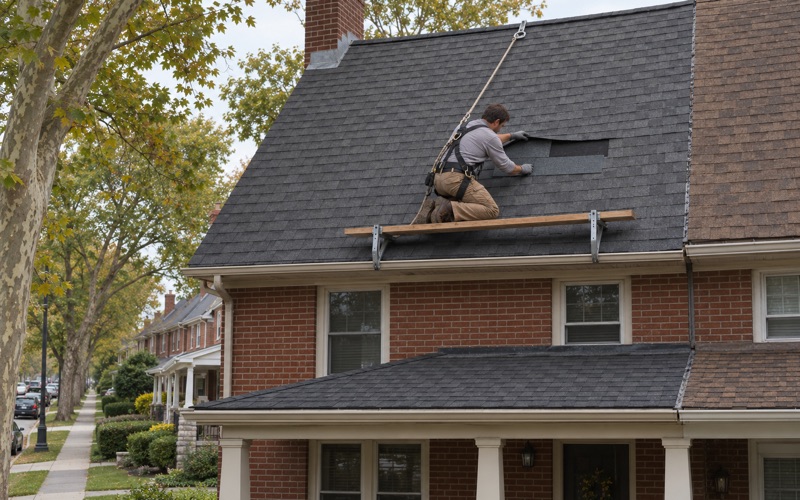
Haverford Roofing brings more than 20 years in the trade to roofing in Upper Chichester, from a single slipped shingle to a full tear-off. When an owner calls about a leak, we give a straight answer on whether the roof can be repaired before replacement is ever on the table, because a sound roof with one bad detail does not need to come off.
A leak call starts in the attic as well as on the roof. Water rarely comes through the ceiling directly below where it got in, so we follow the stains along the rafters and decking back to the real entry point before we price anything. That saves owners from paying for a patch in the wrong place.
Every estimate we write breaks the job into separate lines for tear-off, decking, underlayment, flashing, ventilation and gutters. Two bids laid side by side can then be compared item by item, and an owner can see exactly where one contractor is cutting a corner the other is not. Our contracts follow Pennsylvania’s home improvement law, including the three-business-day cancellation notice.
Boothwyn and the Older Homes of Upper Chichester
Boothwyn is the township’s old crossroads core, with its heart where Chichester Avenue meets Meetinghouse Road. It was McCaysville before it was Boothwyn, a village centered on the Chichester Friends Meeting, which was organized in 1682. Much of today’s neighborhood grew out of Boothwyn Farms, the 350-acre estate around the McCay-Pierce House, which was subdivided starting around 1892.
That history shows up in the housing. The township’s 2021 Boothwyn Town Center Vision Plan reports that over 55% of Boothwyn’s homes were built before 1959, against 26.4% across Upper Chichester, and that only 4.8% of Boothwyn’s homes are newer than 1990. The same report notes that older building stock can be expensive to maintain and has, in some cases, led to deterioration.
Re-roofing Houses from the 1890s to the 1950s
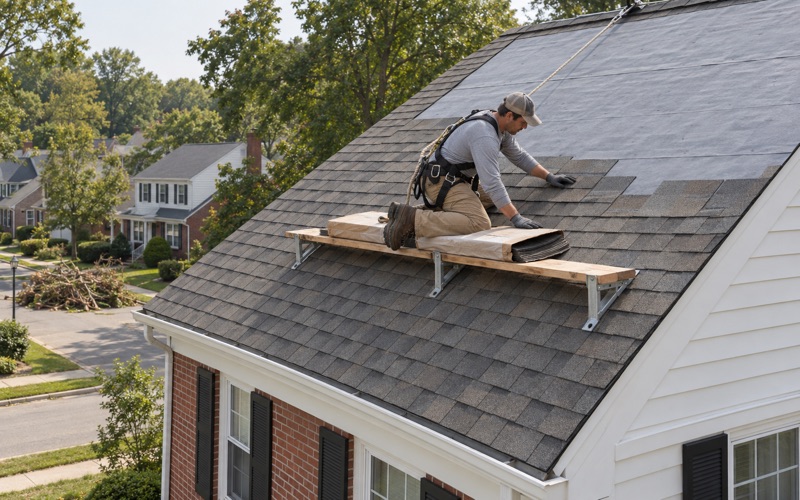
A house from those decades is likely on a second or later roof by now, and the layers above the rafters can tell a long story. Before we price a re-roof, we confirm how many layers are already up there and what sits beneath them, because the two-layer limit in IRC R908 decides whether new shingles can go over or everything has to come off.
Once the old roof is off, older decking is where surprises turn up. Any damaged boards we find are photographed and shown to the owner before they are replaced, at the per-sheet price already written into the contract. Painted fascia and trim on a pre-1978 house are handled under the EPA lead-safe RRP rule.
Ice Barrier and Attic Ventilation
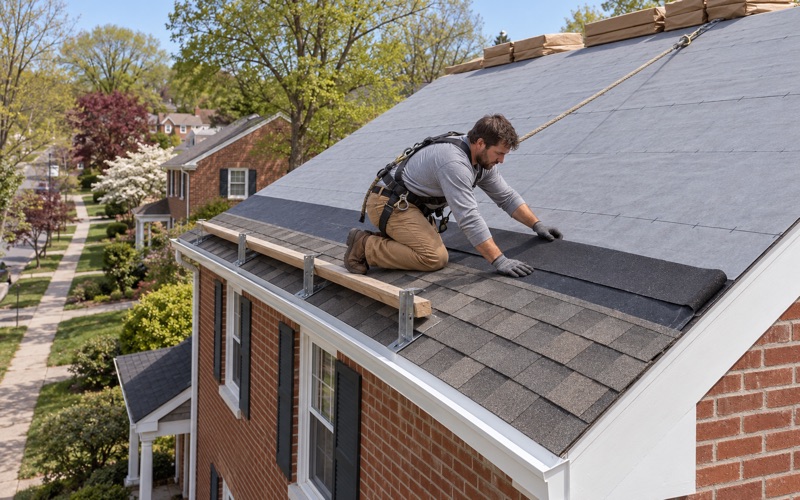
Ice dams form where heat from the house melts snow that refreezes at a cold eave. On a re-roof we run a self-adhering ice and water barrier up from the eaves where IRC R905.1.2 calls for it, and we carry the same membrane into valleys and along the joint where a porch roof meets the wall.
Ventilation gets the same attention. An older attic may have no soffit intake at all, so we work out the net free area before adding a ridge vent, because a ridge vent with nothing feeding it from below does little.
Houses on the Historic Sites Survey
The Chichester Historical Society’s survey counts 41 historic resources in Boothwyn alone. Upper Chichester’s historic preservation ordinance gives structures on the Historic Sites Survey a special demolition permit review, and the vision plan notes there is no historic commission and no official historic district in the township.
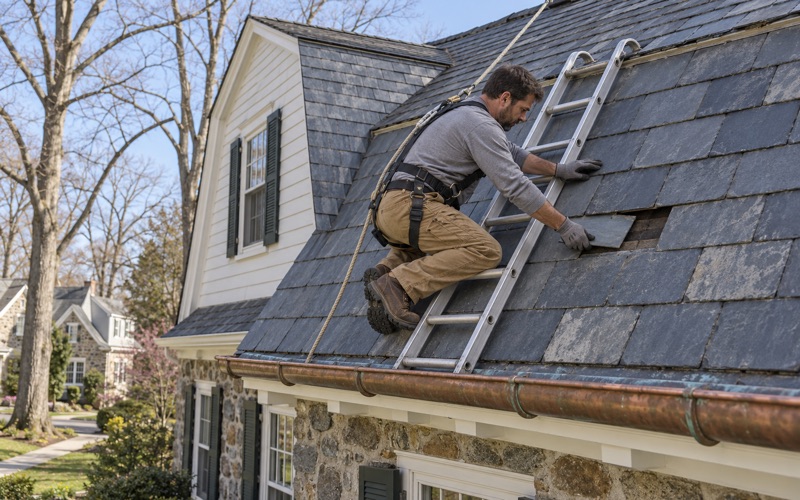
We ask early whether a house appears on that survey, so any question about the demolition review is settled with the township before a crew is scheduled rather than after. On a surveyed house we also lean toward repairing an original detail, such as an old cornice or a slate section, before talking about replacing it.
Looking for roofing closer to Broomall? See Roofing in Broomall.
Porch Roofs and Stone Fronts Around Chichester Avenue
The vision plan describes Boothwyn’s housing and commercial buildings as generally in fair to good condition, older, and mostly built in the 1950s or earlier, with most housing single family. On houses of that age, the porch roof deserves its own inspection, because it is low-pitched and meets the main wall at a joint where water collects.
Some of these houses have stone or stucco fronts, and those walls change how a porch roof is tied in. Mortar joints soften with age, so we inspect the joint where the flashing will go before we cut a reglet into it, and we point out any loose mortar we see for the owner’s mason.
Low-Pitched Porch Roofs
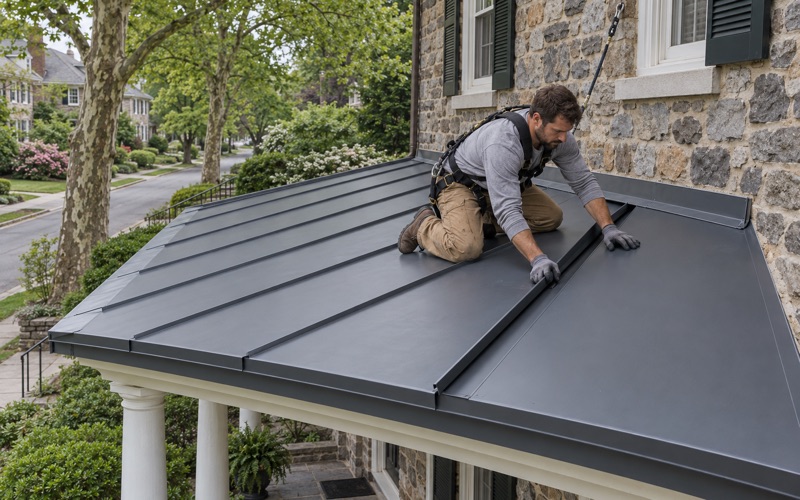
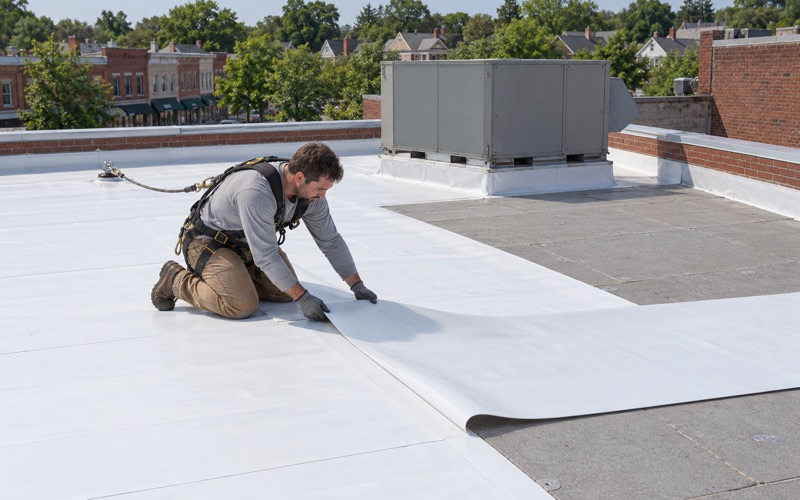
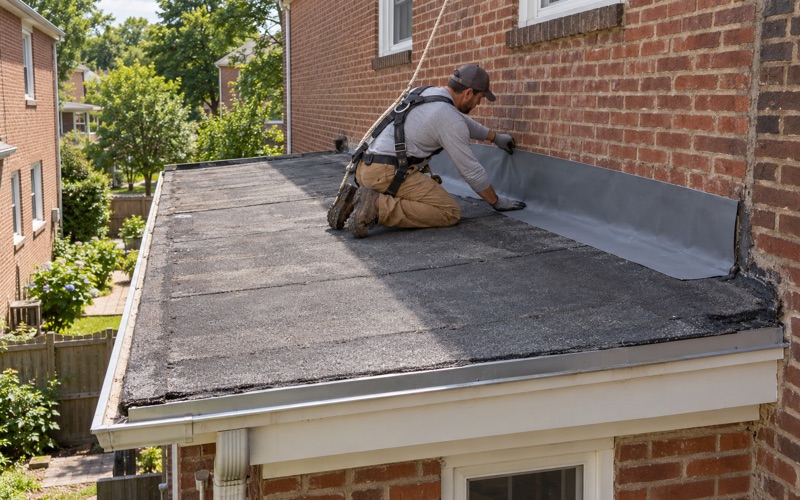
Many porch roofs are too shallow for ordinary shingles to shed water reliably. Depending on the pitch, we may recommend a membrane such as EPDM rubber or torch-down modified bitumen instead, with the change in material spelled out in the written scope so the owner knows why the porch and the main roof differ.
Where a porch roof meets the house, the flashing matters more than the surface. We replace the step, counter and apron flashing with the roof rather than reusing it, and on a stone front the counter flashing is set into a cut reglet in the mortar joint instead of being caulked to the face of the stone.
Chimneys, Twins and Shared Walls
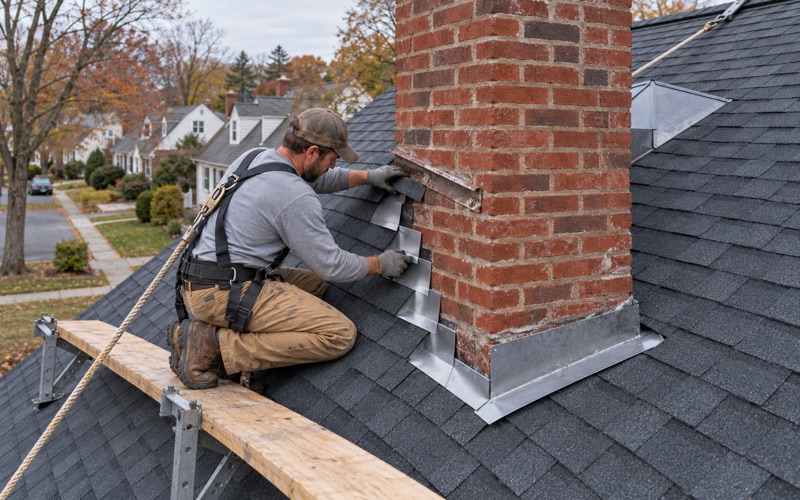
If an older Boothwyn house has a masonry chimney, a wide one needs a cricket behind it so water and debris do not pile up against the brick. We rebuild the chimney flashing with the new roof, since old flashing tucked under fresh shingles is a common reason a new roof leaks early.
Where a Boothwyn house shares a wall with its neighbor, we plan the job around both roofs. The new edge has to tie into the adjoining roof cleanly along the party wall, and we talk through the seam with the owner before work begins rather than leaving it to the crew on the day.
Gutters and Drainage on Chichester and McCay Avenues
The vision plan lists drainage and flooding among Boothwyn’s weaknesses. It notes drainage issues on Chichester Avenue from Malatesta to Meetinghouse, and the 2005 multi-municipal comprehensive plan identified McCay Avenue as an area with significant street and property flooding. The same report adds that few if any structures other than roads sit in the mapped flood zones.
None of that is a roof problem on its own, but it changes how we think about where a roof sends its water. On a street that already struggles to drain, a downspout emptying against a foundation or onto a neighbor’s side yard only adds to the trouble.
Because the vision plan names those two streets, we ask Boothwyn owners near them where water stands in a heavy rain before we lay out a downspout. That short conversation shapes where every downspout on the house ends up.
Gutters Sized and Pitched With the Roof
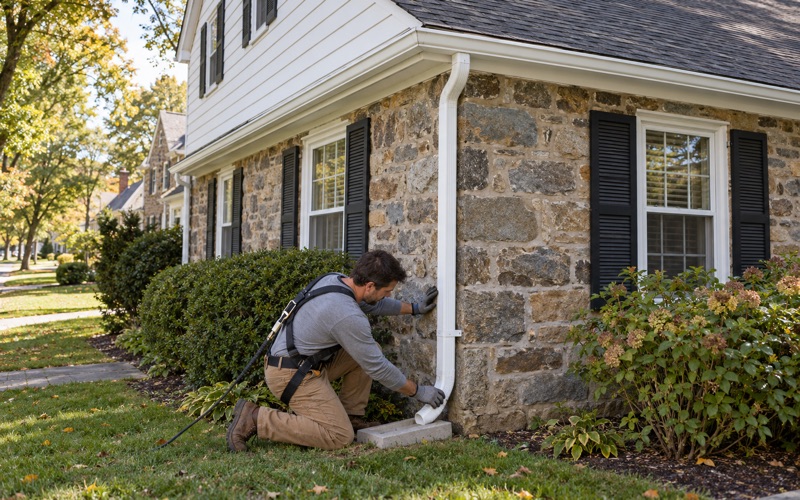
We size and pitch gutters and downspouts as part of the roof job, not as an add-on at the end. On a re-roof that usually means seamless aluminum gutters, downspouts placed where the lot can actually take the water, and a drip edge at the eaves so runoff lands in the gutter instead of behind it.
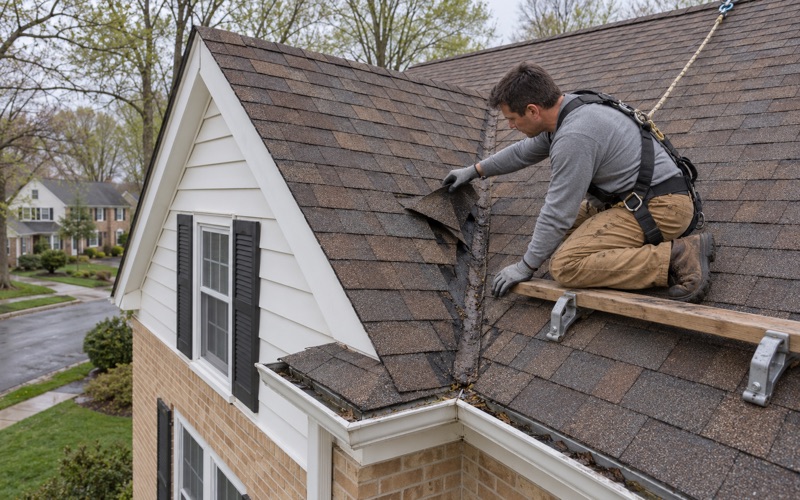
Kick-out flashing at the bottom of each roof-to-wall joint steers water into the gutter rather than down the siding. On an older house where water has been running down a wall for years, that one small piece is often the difference between a dry interior wall and a stained one.
Built-In Box Gutters
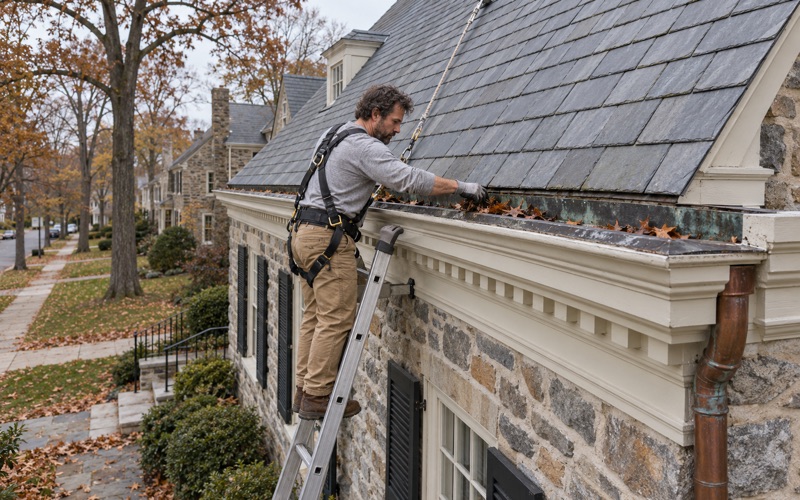
Some older houses were built with box gutters hidden in the cornice instead of hung gutters. When a box gutter leaks, the water goes straight into the eave framing, so we open it up, check the wood, and reline it before we discuss whether the owner would rather convert to a hung gutter.
At the end of every work day, the crew cleans the driveway, yard and gutters and runs a magnet sweep for roofing nails. That matters to the neighbors as much as to the owner.
Permits, Newer Houses and the Rest of the Township
Outside Boothwyn, Upper Chichester’s other communities include Ogden, Twin Oaks and Booth’s Corner, and the housing mix shifts. The vision plan counts 28.5% of the township’s homes as built after 1990, so a roof call elsewhere in the township is more likely to involve a newer house.
Across the whole township, the Census Bureau’s 2024 five-year estimates count 4,384 detached homes among 6,738 housing units, with 1,303 built in the 1950s and another 1,192 during the 1980s. Houses from those two decades are built differently, so we price each one on what we find in its own attic rather than on its age alone.
Newer Houses and Townhome Communities
A newer roof calls for the same attic check and the same straight answer on repair. Wind-lifted shingles, cracked pipe boots and a ridge vent without enough soffit intake are the kinds of problems we find on younger roofs, and many of them can be repaired rather than replaced.
Upper Chichester also has attached row-townhome communities, among them Canterbury Woods, which has its own community association. Before we quote a roof there, we ask the owner to confirm whether the association or the homeowner is responsible for it, since that answer decides who signs the contract.
What the Township Requires for a Re-Roof
Each township sets its own re-roof rule, so we check the rule for the house’s own township before pricing. Upper Chichester’s permit sheet lists an exact roof replacement as needing a building construction permit with no plans, while a roof extension or change needs zoning approval plus a building permit with plot and truss plans.
The township’s License and Inspection Department enforces the Pennsylvania Uniform Construction Code through a third-party agency for plan review and inspections. Its 2022 fee schedule caps the residential roof permit fee at $200 and doubles the fee when a required permit is not obtained, so we build the permit into the estimate from the start.
Storm Claims, Solar and Home Sales
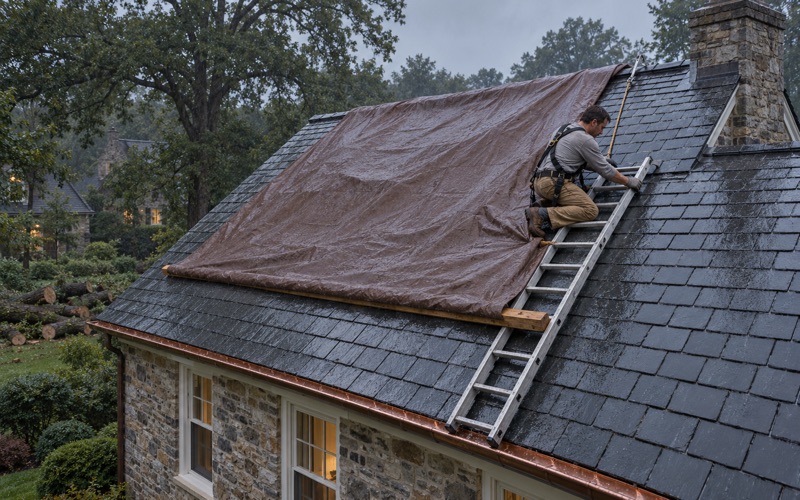
After a storm, we photograph the damage and write it up for the owner’s own insurance claim, and we will meet the adjuster on site when asked. We do not negotiate the claim; that stays between the owner and the insurer.
If solar panels sit on the roof, their removal and reinstall go into the schedule from the first visit. And because every residential sale in Upper Chichester needs a resale Use and Occupancy, an owner preparing to sell may want a roof question settled before listing rather than during it.
- 20+ Years in Business
- Attic Checked on Every Leak
- Line-Item Written Scopes