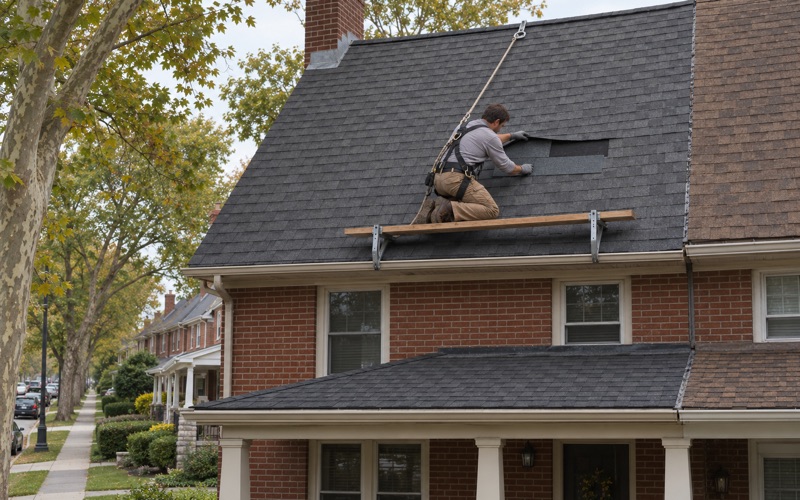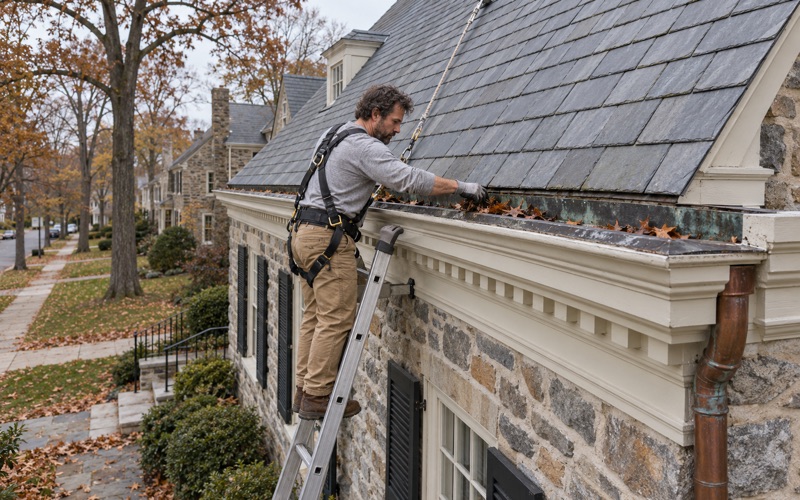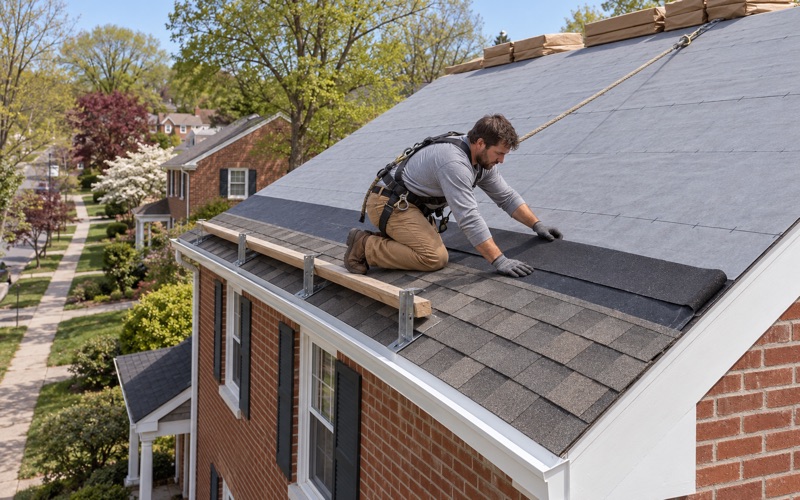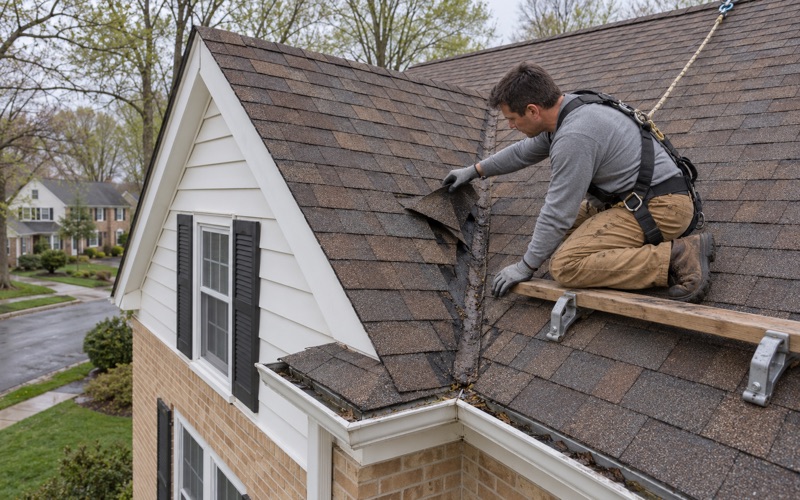
Haverford Roofing has spent more than 20 years on roofing in New Hanover and across Montgomery County, and the work here rarely stops at the house. A call might cover a farmhouse roof, the barn behind it and a run of gutters on a stable, all on one property. We plan those roofs as a set, so the order of work makes sense for how the place is used.
When something leaks, we go into the attic as well as onto the roof, because the stain on a ceiling is often several feet from the place water actually enters. Only after the entry point is found do we put a price on anything. If the roof can be repaired, we say so plainly before replacement comes up at all.
Our written scopes break the job into separate lines for tear-off, decking, underlayment, flashing, ventilation and gutters. That lets an owner set our estimate beside another one and compare it item by item. Contracts follow Pennsylvania’s home improvement law, including the three-business-day cancellation notice and a deposit kept within the legal limit.
Preserved Farms on Hoffmansville and Kulp Roads
New Hanover is still adding working farms to the preserved-farmland rolls kept by Montgomery County and the state. Under the county’s Agricultural Land Preservation Program, which began in 1990, the landowner keeps the farm and the county holds the development rights. That arrangement is why the farm buildings on those parcels are expected to keep working rather than give way to houses.
A Preserved Farm Stays a Farm
On June 1, 2017, the 90-acre Mashintonio No. 2 grain farm on Hoffmansville Road was formally preserved. Reporting at the time noted that a preserved farm cannot be developed for non-agricultural purposes into the future. So the farmhouse, barns and sheds on land like that stay part of a working operation, and their roofs are kept up rather than torn down with the buildings.
We do not treat a roof on preserved ground as a stopgap, because the land is staying in agriculture. A barn roof there is a long-term asset, and we price materials and flashing with that service life in mind. Our advice on repair versus replacement follows how the building is used, not a guess about what the parcel might become.
Equine and Crop Farms on Kulp Road and Beyond
The list keeps growing. In April 2026 a 41-acre equine farm at 704 Kulp Road was preserved, followed in June 2026 by a 16-acre crop and livestock farm. In August 2025 the 16-acre Jersey Native fruit and vegetable farm joined the rolls, fully funded by the state.
Those are different operations with different buildings. An equine operation typically runs on stables and run-in sheds, while a crop farm leans on equipment sheds and storage barns. We look at each structure on its own terms, from roof pitch and span to what is stored or stabled underneath, before we recommend a material.
Farmhouse Roofs on Working Land
The farmhouse on a working parcel is often the oldest roof on the property, and New Hanover still has 364 housing units built in 1939 or earlier. Older houses here can carry layered roofs, worn chimney flashing and fascia painted long before 1978. We follow the EPA lead-safe rule when that painted trim is disturbed.
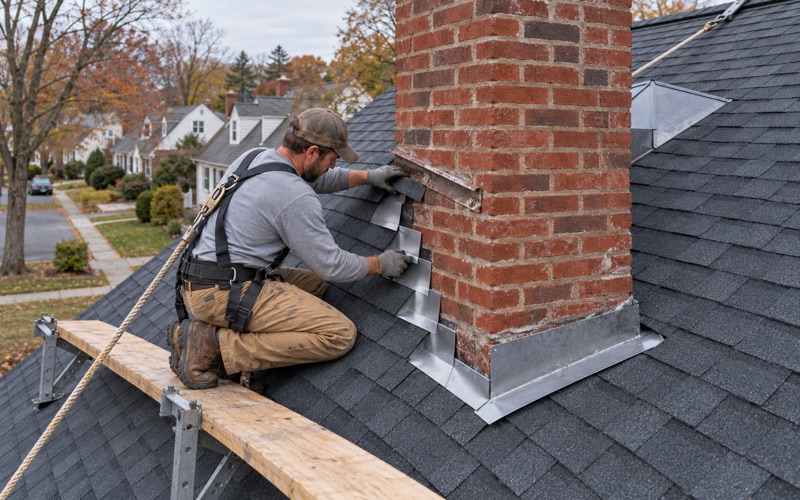
On a farmhouse we replace step, counter and chimney flashing along with the roof instead of reusing old metal under new material. Where the old roof comes off and the decking underneath is damaged, we photograph it and show the owner before any sheet is replaced, at the per-sheet price already written into the contract.
Looking for roofing closer to Woolwich? See Roofing in Woolwich.
Barn, Stable and Outbuilding Roofs That Stay in Service
A barn roof covers a wide span with few interior walls, so a small leak can travel a long way along purlins or rafters before it drips. Hay, feed, equipment and animals sit underneath, and each reacts badly to water. We treat agricultural buildings as full roofing jobs, with the same scope detail a house gets.
Metal and Shingle on Barns
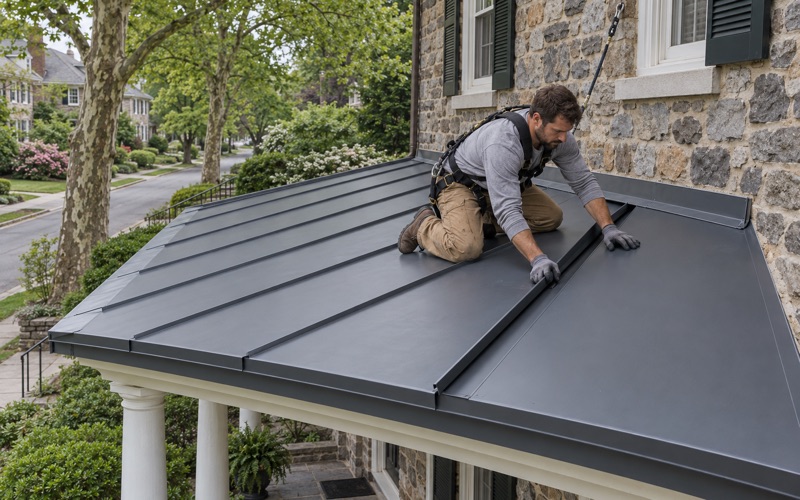
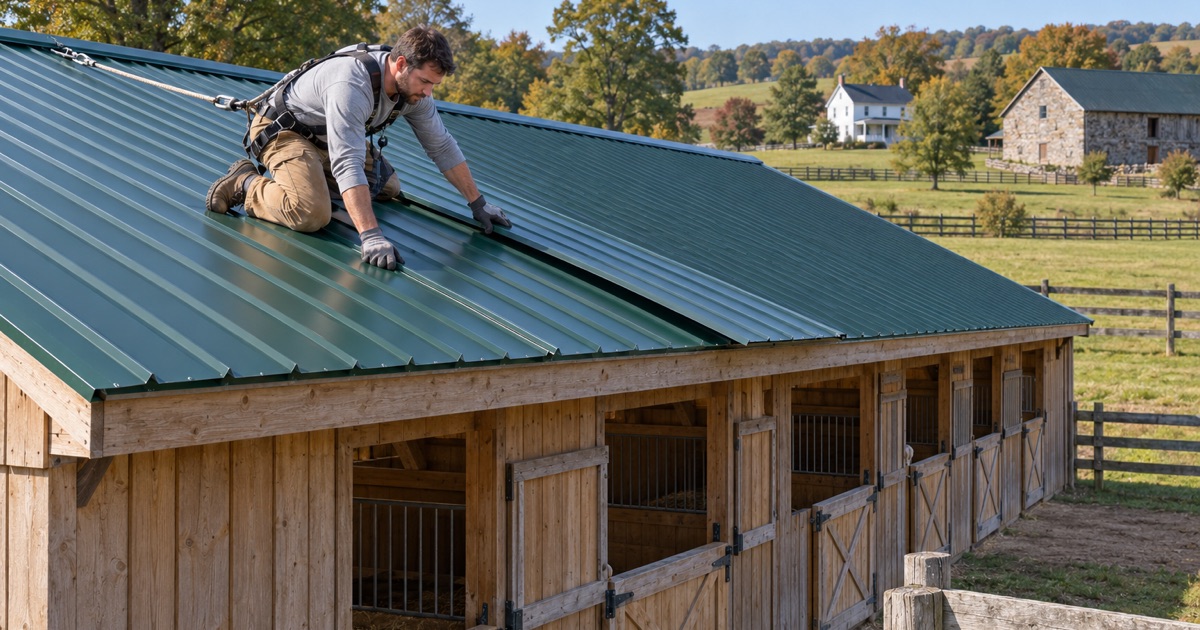
Many barns and equipment sheds carry exposed-fastener metal panels, and the rubber washers on those screws age out long before the steel does. Re-fastening and resealing can buy years on a sound panel roof. Where panels are rusted through, standing seam metal roofing hides its fasteners and leaves far fewer holes for water to find.
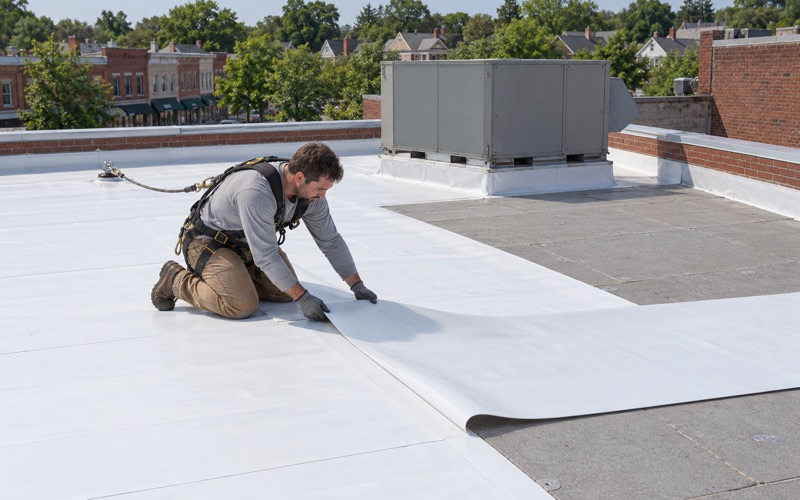
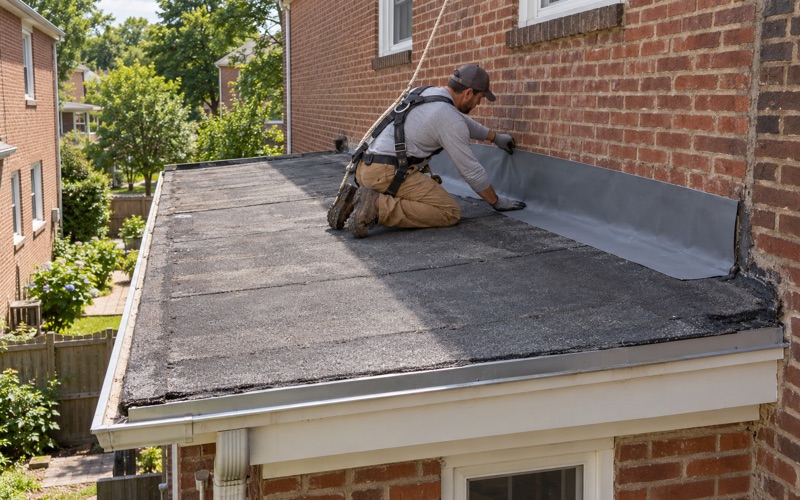
Some barns and older outbuildings are shingled to match the farmhouse, and architectural shingles such as GAF Timberline HDZ or CertainTeed Landmark remain a fair choice on steeper pitches. On a low-slope lean-to, we look at EPDM rubber membrane or a modified bitumen system instead, since shingles are not made for water that moves that slowly.
Stables and Livestock Under the Roof
Work over a stable has to be scheduled around the animals. Horses can spook at noise from overhead, so we talk through the sequence with the owner, decide which stalls are emptied on which day, and keep tear-off sections short enough to dry-in before evening. Nothing is left open over a stall overnight.
Cleanup matters more on a farm than on a lawn. A dropped roofing nail in a paddock or an aisle can end up in a hoof or a tractor tire, so every work day ends with a magnet sweep of the yard, the lanes and the driveway. The gutters are cleared of debris before the crew leaves, too.
Gutters on Barns and Outbuildings
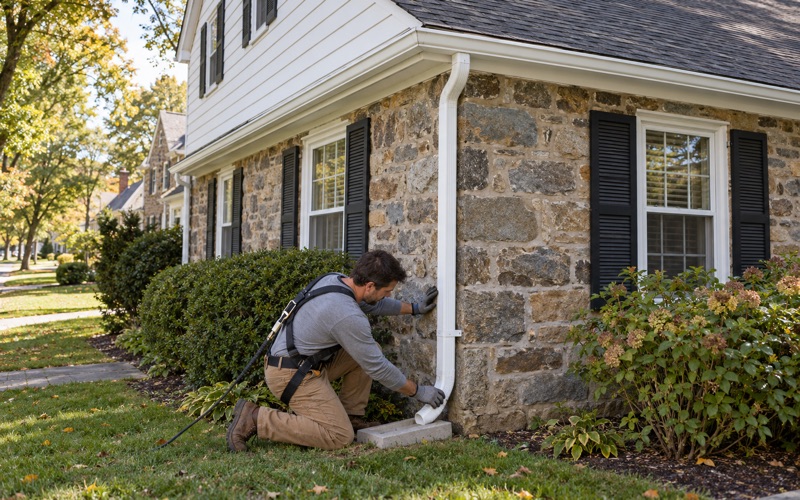
A large barn roof sheds a lot of water onto a small strip of ground, and that is often where a muddy entrance or a soft foundation edge starts. We size gutters and downspouts to the roof area they actually drain and pitch them with the roof work, not as an add-on once the crew is packing up.
Seamless aluminum gutters handle most farm buildings well. Where a downspout empties near a stall door or a feed area, we route it away so the water lands somewhere the owner can live with, and we fit kick-out flashing wherever a lower roof meets a wall.
Newer Subdivision Roofs from the 2000s and 2010s
Away from the farms, much of New Hanover is newer than people expect. Census estimates count 1,047 housing units built from 2000 to 2009 and 1,137 more from 2010 to 2019, and 45.0% of the township’s housing was built in 2000 or later. Of the occupied homes, 98.1% are lived in by their owners.
The First Replacement Cycle
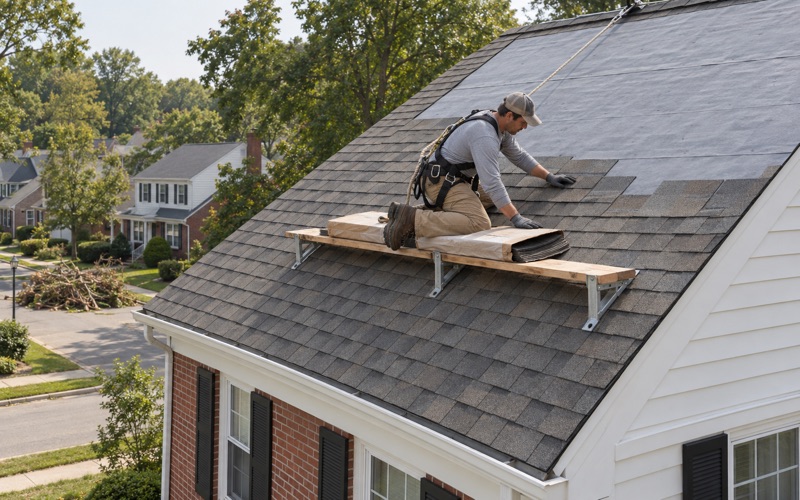
Three-tab and early architectural shingles installed in the 2000s are reaching the age where granule loss, lifted tabs and cracked pipe boots show up. A roof from that decade is not automatically due for replacement, and we tell an owner when a repair will do. When it is time, we write the new layers into the scope one by one.
On a full replacement we lay ASTM D1970 self-adhering ice and water barrier at the eaves, synthetic underlayment across the field, new drip edge at eaves and rakes, and a ridge vent balanced against soffit intake. Ventilation on houses of this age is worth checking, because an unbalanced attic shortens the life of new shingles.
Attached Homes and Shared Walls
Most of the township is single-family detached, but census estimates still count 376 attached units. On a twin or townhouse, the roof does not stop at the property line, and the joint over the shared wall is where leaks tend to start. We plan that seam with the neighbor’s roof in view, so the new work ties in cleanly.
Where an attached home sits in a planned community, the association’s documents may govern roof color or material. Pennsylvania’s Uniform Planned Community Act sets the framework those associations operate under. We ask the owner to check those before a product is chosen, so the order is placed once.
Solar Panels on Newer Roofs
Newer houses with open south-facing planes are common places for solar arrays. If a roof under panels needs work, the panel removal and reinstall go into the schedule from the start, coordinated with the solar installer. We do not find out about the array on the morning the crew arrives.
A roof with ten years or less left on it is often worth replacing before panels go back on, since pulling them a second time costs the owner twice. We give a straight read on the remaining life of the shingles so that decision is made with real information.
Planning Roof Work on New Hanover Farm and Rural Properties
New Hanover sits in the National Weather Service’s Western Montgomery forecast zone, PAZ103, served by the Mount Holly office, and parts of the township carry Gilbertsville or Pottstown mailing addresses. Swamp Pike and Dotterer Road appear in preservation records too, and a farm lane off roads like those has to take a roll-off container and a material truck.
Checking the Township’s Own Rule
Each township in our service area sets its own re-roof permit rule, so we never assume one township’s answer holds in the next. Before we price a house, barn or stable here, we confirm the township’s current requirement for that building and write the answer into the scope.
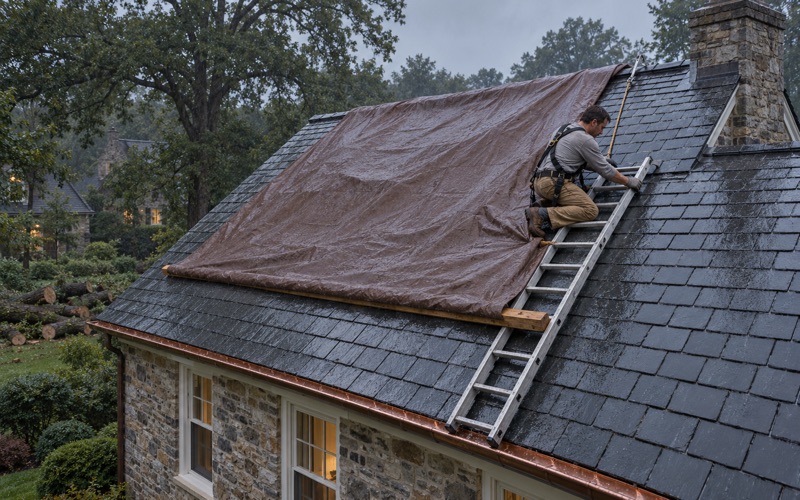
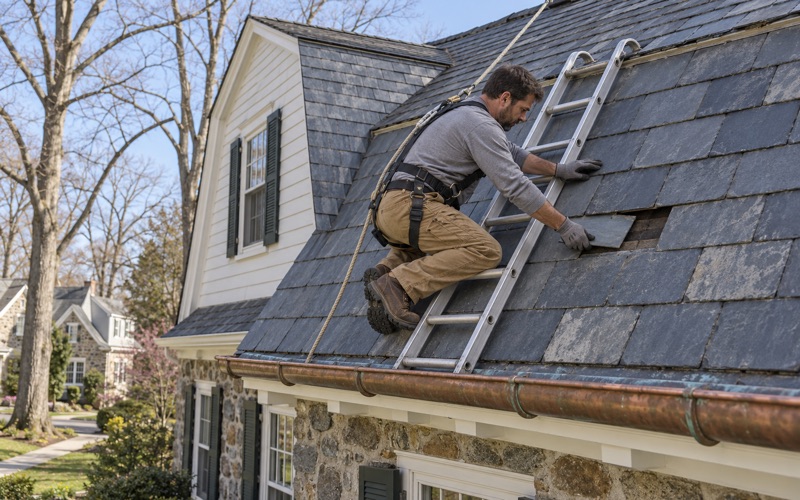
A tear-off decision is written down the same way. If an older farmhouse already carries two layers, or has slate underneath, we say up front that the old material comes off rather than burying it. Sound slate gets repaired slate by slate with copper nails and slate hooks before anyone talks about removing it.
Storm Damage on Houses and Barns
After a wind or hail event, we photograph the damage on every affected building and write it up so the owner has a record for their own claim. A barn panel peeled back at the eave and a farmhouse missing shingles on one slope both go into the same report.
When an owner asks, our crew will meet the insurance adjuster on site and walk the roofs with them. We describe what we found and what the repair involves, but we do not negotiate the claim; that stays between the owner and the insurer.
Timing Work Around the Farm Calendar
A working farm has busy weeks, and a roof crew in the barnyard during planting or harvest is a problem. We ask about the calendar early, keep equipment clear of gates and lanes the owner needs open, and stage material where it will not block a tractor or a horse trailer.
On a property with several roofs, we usually suggest an order: the building whose roof is failing first, then the ones that can wait a season. Each one is priced on its own line, so the owner can schedule the farmhouse this year and the equipment shed the next without reworking the estimate.
- 20+ Years in Business
- Attic Checked on Every Leak
- Line-Item Written Scopes