
Haverford Roofing installs metal roofing in Haverford, PA, serving surrounding cities including Uwchlan, Yeadon, West Bradford, Upper Providence Township, Nether Providence. In 20+ years of roofing, the metal work we do most often is not a whole house but the trouble spots: a porch roof that keeps leaking at a shallow pitch, a bay window roof where snow sits, or a shed dormer that shingles never sealed.
We also install full metal roofs where an owner wants a long-life alternative to asphalt. Either way, the scope tells you what the panels are, how they are fastened, and exactly how they tie into the shingle, slate or brick around them.
That tie-in is where metal jobs succeed or fail. A metal porch roof flashed carelessly into a stone wall or under a shingle main roof will leak at the joint no matter how good the panels are, so we treat the transitions as the main part of the job.
Types of Metal Roofing
Standing Seam Panels
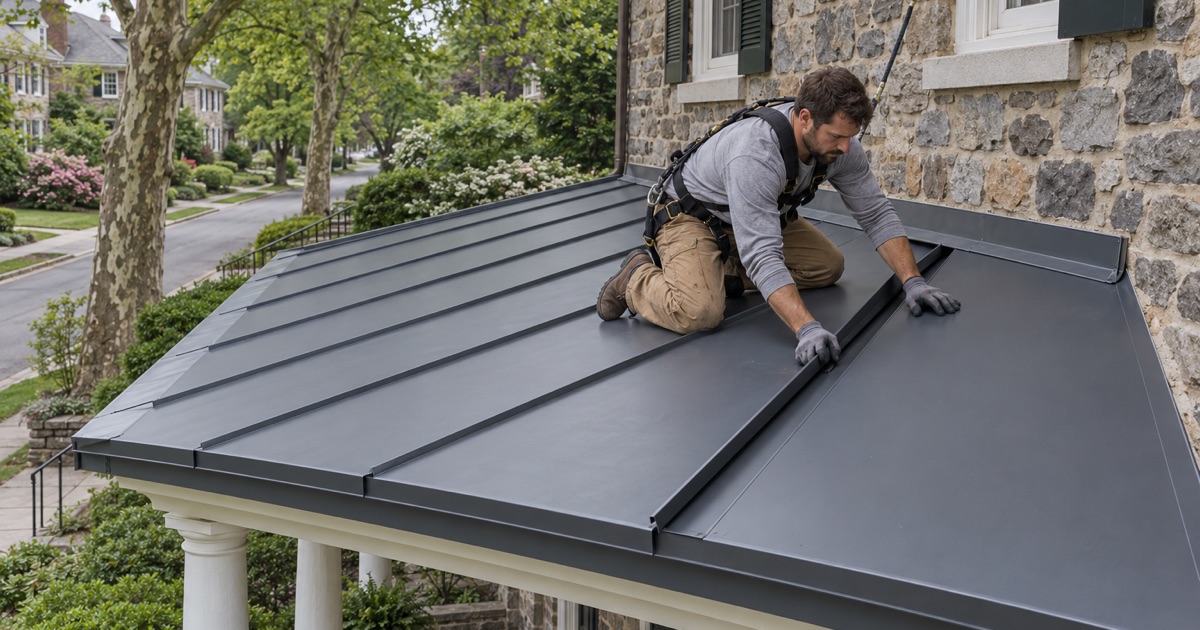
Standing seam panels run from ridge to eave with raised seams locked together and fasteners hidden under the seam. With no exposed screws to back out and no horizontal joints, they keep water out at pitches too shallow for shingles.
That makes standing seam the natural choice for porches, bays and low-slope additions. On a main roof it gives clean lines that suit both traditional and modern houses.
Exposed-Fastener Panels
Exposed-fastener panels are screwed through the face with rubber-washered screws. They cost less and suit outbuildings, garages and some agricultural-style designs.
The washers age and the screws loosen with expansion, so these roofs need periodic checking. On a house we usually recommend standing seam, and we explain the difference in price and upkeep plainly.
Copper and Other Specialty Metals
Copper has covered bay roofs, cupolas and porch roofs on older Main Line houses for generations, often next to copper valleys and half-round copper gutters. It weathers from bright to brown to green and lasts a very long time.
Where an original copper roof is sound, we repair it with copper rather than replacing it. Mixing aluminum or galvanized steel into copper work causes corrosion where the metals meet.
Where Metal Fits on a Main Line House
Porch and Bay Window Roofs
Porch roofs often have very little pitch, and bay window roofs sit right where snow collects against the house. Shingles on these shallow slopes let water back up under the laps, especially when ice forms.
A standing seam panel avoids that problem because its seams are raised above the water line. We flash the top edge under the wall siding or into the masonry so water cannot get behind it.
Low-Slope Dormers and Additions
Shed dormers and rear additions are frequently framed at pitches that are too low for asphalt but too steep to look right with a flat membrane. Metal works well in that middle ground.
We check the pitch before recommending it, because below a certain slope a membrane roof is still the better answer. The scope explains why we chose one over the other for each section of your roof.
Whole-House Metal Roofs
A full standing seam roof is a significant investment, but it can outlast more than one asphalt roof. It also sheds snow readily and works well with solar panels clamped to the seams.
We review how the change will look against the house’s stone, brick or siding, and whether the house is on Haverford Township’s Historic Resource Inventory, where removing or covering part of the roof goes to the township for review.
Installation Details That Matter
Underlayment and Deck Preparation
Metal goes over a solid deck with underlayment rated for the heat that builds under metal panels. At eaves and valleys we install self-adhering ice and water barrier, as on any roof.
On a tear-off, damaged decking is photographed and shown to you before it is replaced at the per-sheet price in the contract. A flat, sound deck also keeps long metal panels from showing every dip underneath them.
Allowing for Expansion
Metal panels grow and shrink with temperature, more than most roofing materials. Standing seam systems use clips that let the panels slide without tearing fasteners loose.
We follow the manufacturer’s clip spacing and leave room at the ridge and eaves for that movement. A roof installed without it buckles, oil-cans or pops fasteners within a few seasons.
Flashing at Walls, Chimneys and Valleys
Where metal meets a wall, we turn the flashing up behind the siding or set counter flashing into a reglet in the masonry. Chimneys get proper step and counter flashing and a cricket on the uphill side where needed.
We also keep dissimilar metals apart. Copper and aluminum or galvanized steel touching each other in the presence of water corrode quickly, so fasteners and flashing match the panel material.
Snow Guards and Gutters
Snow slides off metal roofs in sheets. Over entrances, walkways and lower roofs, snow guards hold it until it melts, protecting people, gutters and the roofs below.
Gutters under a metal roof take water arriving faster and with more force, so we size and secure them for it. They are listed as their own line on the estimate.
Repairing Existing Metal Roofs
Loose Seams, Fasteners and Sealant
Older metal roofs usually leak at a handful of points rather than across the whole surface: a seam that has opened, screws whose washers have dried out, or sealant at a wall joint that has cracked. Those are repairs, and we treat them that way before talking about a new roof.
We re-seam or re-crimp opened joints, replace failed fasteners with new washered screws of the matching metal, and rebuild wall flashing where caulk was standing in for metal. The repair scope lists each fix and its price.
Rust, Coatings and Worn Finishes
Surface rust on a steel roof is common where the finish has worn, and it can often be cleaned and coated if the metal underneath is still solid. Rust that has eaten through a panel means that panel needs replacing.
We probe suspect areas and show you photos of what we find, so you can see whether a coating will buy years of service or whether the panels have reached the end of their life.
- 20+ Years in Business
- Attic Checked on Every Leak
- Line-Item Written Scopes