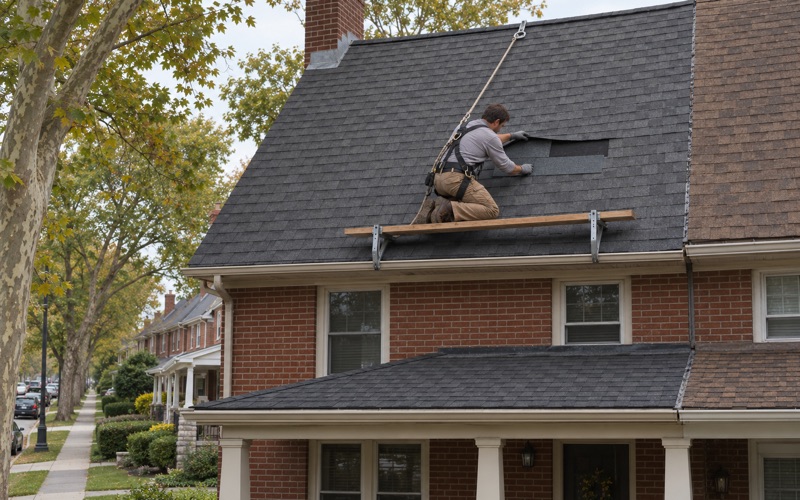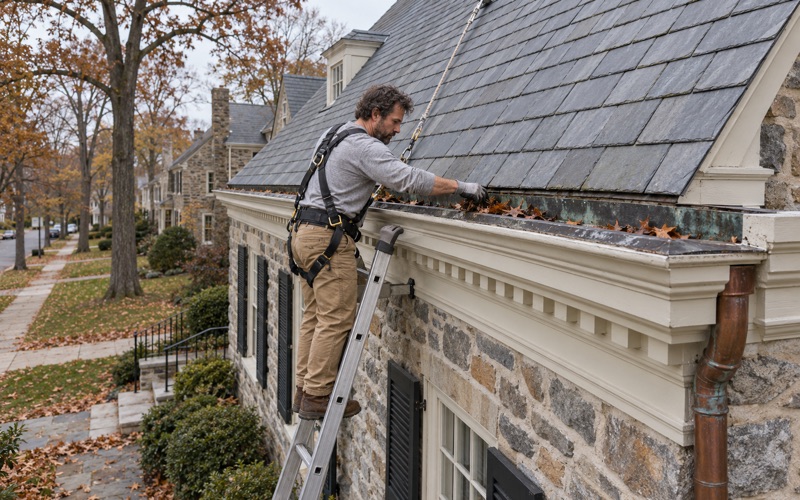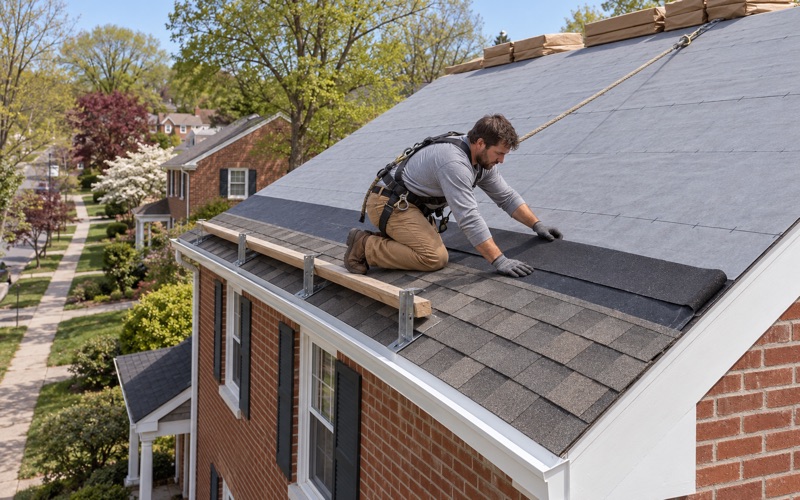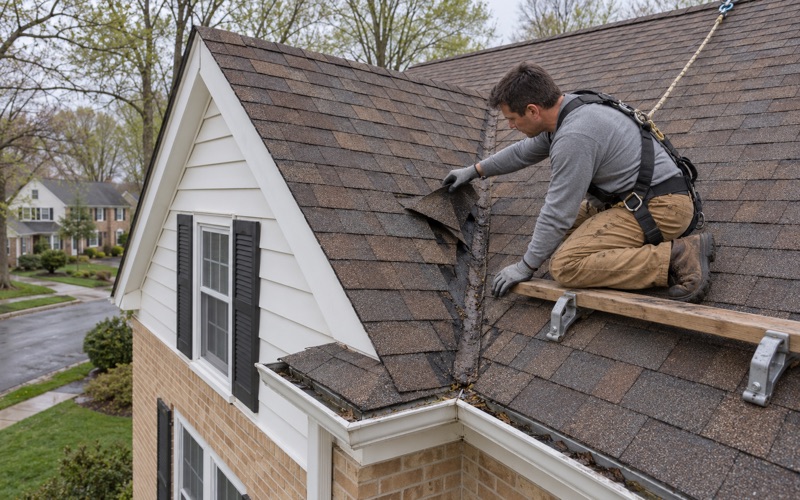
Haverford Roofing brings more than two decades of roofing in Mantua and across the region to homeowners who want a straight answer before they spend money. Every leak call starts in the attic as well as on the shingles, so we can follow the water to the spot where it actually enters. Only after that do we price anything, and only after we have said whether a repair will do.
Some Mantua roofs carry something extra: a solar array. Panels change the order of a roofing job, because the slope underneath cannot be stripped, decked or reshingled while the array is still bolted to it. We put the solar company’s removal and reinstall into the schedule from the first conversation, so nobody discovers on the morning of tear-off that the panels are still up.
The township’s own rules shape where those panels sit, how high they ride and what paperwork backs them, and that shapes how we plan the roof below. This page walks through those rules from a roofer’s side: where the array goes, what the mounting drawings show, how a re-roof under panels runs, and what the fire district now wants to see when a house with solar is sold or rented.
Solar on a Mantua Roof Goes on the Back
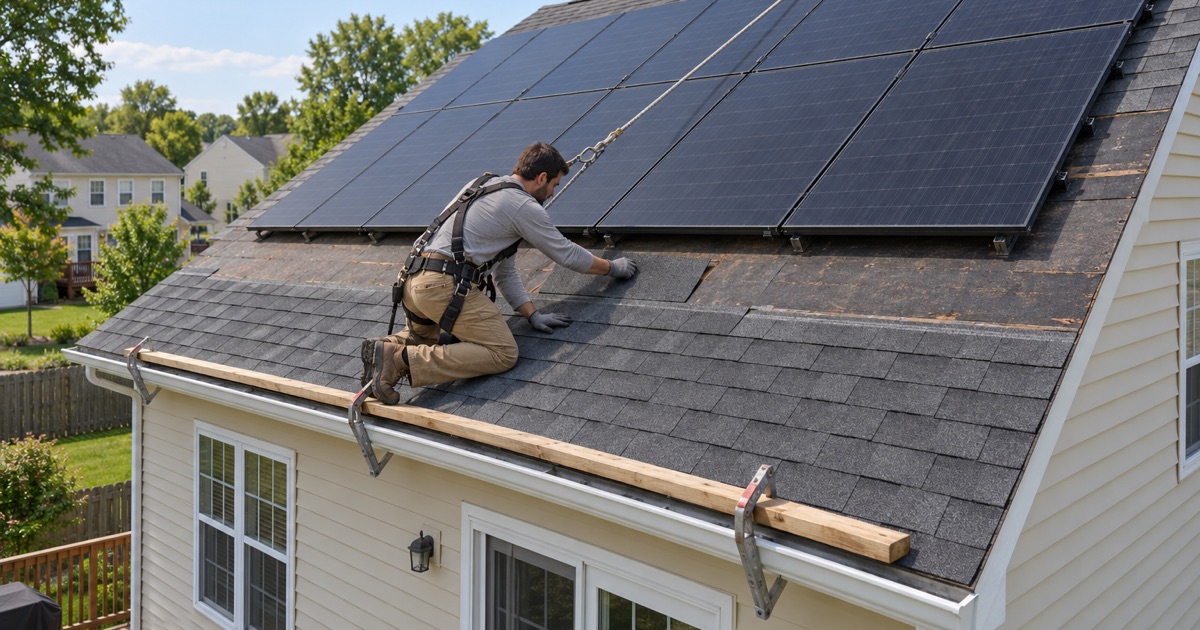
Mantua Township regulates rooftop solar through Ordinance O-03-2010, which added a Solar Energy Systems article to Chapter 230 of the township code. Panels are allowed as a rooftop installation in any zoning district, and every system needs approval from the Zoning Officer and the local Construction Office before it goes up. The placement rule is the part that matters most to a roofer.
The Rear Roof Rule
Under the ordinance, rooftop panels must be installed on the rear roof area. The exception runs through the Zoning Officer, who serves as the ordinance’s Administrator: if the applicant shows that the proposed layout cannot be installed on the rear roof, the Administrator can endorse a front-roof array in writing. Without that written endorsement, the array belongs on the back of the house.
For us that means a Mantua re-roof under solar usually concentrates on one slope. The rear slope is the one carrying the mounts, the penetrations and the wiring, while the front is often clear shingle that can be handled like any other roof. We look at both before pricing, because a clean front and a worn rear can call for very different scopes.
When Panels Go on the Front
Front-slope arrays are allowed in Mantua, but each one comes with a paper trail. The township’s solar checklist asks for a Front Roof or justification letter from the contracted solar company whenever panels are proposed for the front of the dwelling roof. If you own a house with panels facing the street, that letter and the written endorsement are worth finding before any roof work is planned.
The paperwork tells us why the array went where it did, which can matter when the panels come off. A front array sitting over the most visible slope also changes what a homeowner sees from the curb once new shingles go down around it, so we talk through color and layout with that slope in mind.
Ground Mounts Are a Different Matter
The ordinance allows ground-mounted panels only on lots of at least 3 acres, with a 250-foot buffer from the property line. A house on a smaller lot has no ground-mount option, which leaves the roof to carry the array. When it does, the roof under it has to be planned to outlast the panels or to come up cleanly when they are moved.
Looking for roofing closer to East Bradford? See Roofing Services in East Bradford.
Racking, Fastenings and the 12-Inch Limit
Mantua’s 2026 solar checklist is a zoning document, and it says so: its requirements are for zoning only and do not cover the Construction Office. Even so, the drawings it asks for are the most useful record a roofer can find on a house with panels. Each application, filed with a $100 fee, includes a property survey, the system’s size in kilowatts and an aerial view of overhead lines.
Sealed Drawings of the Racking
The checklist calls for two sets of sealed drawings showing the exact fastening of the racking system, including the distance from the roof top to the top of the panels. The ordinance separately requires a structural design signed and sealed by a New Jersey professional engineer. Together those documents show where every mount was meant to go and how it was meant to attach.
We ask Mantua owners for a copy whenever panels are involved. Each fastening on that drawing is a hole through the roofing into the deck or framing, and each one has to be flashed and sealed again when the roof is replaced. Knowing the layout ahead of time lets us price the rear slope honestly instead of guessing at what sits under the rails.
Height Above the Roof
Rooftop panels in Mantua may not stand more than 12 inches above the surface of the roof. They must also sit within the actual edges of the roof area and may not overhang any part of the edge, and they cannot interfere with plumbing fixtures that come through the roof.
Those limits help a roofer. An array held inside the edges leaves the eaves, rakes and drip edge free, so the perimeter of the rear slope can be inspected and replaced without working under overhanging glass. The low profile keeps the gap under the panels tight, which is why debris and gutter flow under an array deserve a look on every visit.
Wiring and the Utility
Wires leading down the side of the house from a rooftop array are to be placed and tacked as aesthetically as possible, and the ordinance requires written notice to Atlantic City Electric. Where conduit crosses a fascia or runs past a gutter, we plan our gutter and trim work around it rather than through it.
Re-Roofing Under an Array on the Rear Slope
When the shingles under a rear-slope array wear out, the panels have to come off before that slope can be replaced. Removing and resetting them is the solar company’s work, not ours, so the job becomes two trades sharing one calendar. We build that sequence into the estimate so the roof is never left open waiting on the other crew.
Scheduling the Panel Crew
Before we set a date, we ask the owner to bring in the company that installed or now services the array. Their crew takes the panels and racking down and stores them, we tear off and rebuild the slope, and they return to reset the system on the new roof. Our written scope names each handoff so everyone knows which day belongs to whom.
A gap between removal and reinstall is normal, and it is the window where weather matters most. We keep the slope dried in with underlayment at the end of each work day, and the driveway, yard and gutters are cleaned every evening, with a magnet sweep for roofing nails.
What Happens at the Mounts
The sealed racking drawing is our map once the old roof is off. Every former mount location is a penetration we inspect, because a fastening that leaked slowly under the panels can leave soft or stained decking that was hidden from view while the array was in place.
Damaged sheets are photographed and shown to the owner before we replace them, at the per-sheet price written into the contract. New underlayment and fresh shingles then go down across the whole slope, so the solar crew resets its mounts into a sound deck rather than into patched roofing.
Flashing and Line Items
Step and counter flashing along any wall the rear slope meets is replaced with the roof, not reused under new shingles, and the same goes for chimney flashing. Our written scope lists tear-off, decking, underlayment, flashing, ventilation and gutters as separate lines, so an owner comparing our number with another estimate can match the two item by item.
The panel removal and reinstall is noted on its own line too, as work the solar company prices separately. That keeps a re-roof under solar from looking cheaper or dearer than it really is when you set two bids side by side.
Selling a Mantua House With Solar
When a Mantua house is sold or rented, the Mantua Township Fire District publishes a pre-inspection checklist for residential resales and rentals. It covers smoke alarms by build era and carbon monoxide alarms near sleeping areas, and it does not list the roof. Any roof evaluation during a sale is a matter for the buyer, the seller and their own inspectors.
The Multiple Sources of Power Label
The checklist added a new item for homes with a secondary power source, which includes solar panels, battery storage and backup generators. Those homes need a permanent label by the main electrical panel and by the electric meter, with wording similar to “Caution: Multiple Sources of Power.” The label may not be handwritten, and one that meets ANSI Z535.4 satisfies the requirement.
The label is electrical, not roofing, and we do not supply or install it. We mention it because an owner re-roofing under panels before listing the house will want the rest of the sale checklist on the same calendar.
Timing a Re-Roof Before a Sale
If the rear slope under an array is near the end of its life, a sale is a natural point to deal with it, since a buyer will see the shingles around the panels on any roof inspection they order. Coordinating the solar company’s removal and reset takes lead time, so we suggest calling us well before the listing date rather than in the final weeks.
We also give a straight answer when a sale does not need a new roof. A sound rear slope with a few tired boots or a lifted flashing can often be repaired around the array, and we put that option in writing first so the seller can weigh it against a full replacement.
A Sewell Address, a Mantua Rule
Parts of Mantua Township mail as Sewell, and localities such as Barnsboro sit inside the township as well. An owner with a Sewell address may not think of the house as being in Mantua, but if it lies within the township, Mantua’s solar ordinance is the one that governs the array.
We confirm which township a house sits in before we price the work, since each one in our service area sets its own rules. For a Mantua roof with panels, that check tells us to ask for the sealed racking drawings and the zoning paperwork, and to plan the rear slope around them from the start.
- 20+ Years in Business
- Attic Checked on Every Leak
- Line-Item Written Scopes