
Haverford Roofing handles emergency roof repair in Haverford, PA, serving surrounding cities including Uwchlan, Yeadon, West Bradford, Upper Providence Township, Nether Providence. When a limb comes through the roof, wind strips a section of shingles or water starts pouring through a ceiling, our first job in 20+ years of roofing has always been the same: stop the water, then figure out the right repair.
An emergency repair has two parts, and we keep them separate. The temporary repair makes the roof watertight now, usually with a tarp or a quick patch, and the permanent repair comes once the roof is dry and we can see the full damage from above and from the attic.
We also photograph everything as we go. Those photos and a written description of the damage are yours to send with your insurance claim, and they make the difference between a claim that moves and one that stalls while everyone argues about what happened.
What Counts as a Roof Emergency
Fallen Trees and Limbs
Large trees line many streets and yards around Haverford, and storms bring them down. On July 11, 2026 a trained spotter estimated gusts up to 60 mph in the Ardmore section of Haverford Township, and tree limbs fell across the Norristown High Speed Line near Penn Wynne during the same storm.
A limb on a roof can crack rafters as well as puncture the deck. We do not stand on a damaged section until we know what is holding it up, and we tarp around the opening once the limb is removed or secured.
Wind-Stripped Shingles
High wind can peel away whole courses of shingles, leaving underlayment or bare decking exposed. Once that layer is open, the next rain goes straight into the attic.
We cover the exposed area and secure the edges of the surrounding shingles so the damage does not spread in the next gust. Then we check the rest of the roof for shingles that were lifted but not yet torn loose.
Active Leaks Through the Ceiling
A leak that suddenly appears in a storm can come from a blown-off pipe boot, a failed chimney flashing or water driven sideways under a wall joint. When it is pouring in, the source matters less than stopping it.
We go into the attic to find where the water is entering and cover that area from above. The detective work that pinpoints the exact failure comes later, when the roof is dry and safe.
Ice Dam Leaks During Thaws
In winter, ice dams along the eaves can push meltwater under the shingles and into exterior walls during a thaw. The leak often shows above a window or along the top of a wall.
We carefully open channels in the ice so water can drain, without chopping into the shingles, and make temporary repairs where water is coming in. The permanent fix includes ice and water barrier at the eaves and a look at the attic insulation and ventilation.
What to Do Before We Arrive
Keep Everyone Safe
Do not go onto a wet or damaged roof, and keep people away from sagging ceilings and anywhere water is near electrical fixtures. If water is reaching wiring or a light fixture, shut off that circuit at the panel.
If a tree has brought down wires, stay well away and call the utility. No roof repair is worth the risk of a fall or a shock.
Limit the Water Damage
Put buckets under drips and move furniture, rugs and electronics out of the way. If a ceiling is bulging with water, a small hole at the lowest point lets it drain into a bucket instead of collapsing a larger area.
Owners are generally expected to take reasonable steps to prevent further damage after a storm. Doing these simple things, and keeping receipts for any supplies, helps when you file a claim.
Photograph Everything
Take dated photos and video of the damage inside and outside before anything is moved or cleaned up. Include the ceiling, walls, floors, belongings and any debris on the roof that can be seen safely from the ground.
These pictures, together with ours from the roof and attic, give your insurer a clear record of what happened and when. Keep the originals with their dates rather than edited copies.
Temporary Repairs and Tarping
Tarping That Holds in the Wind
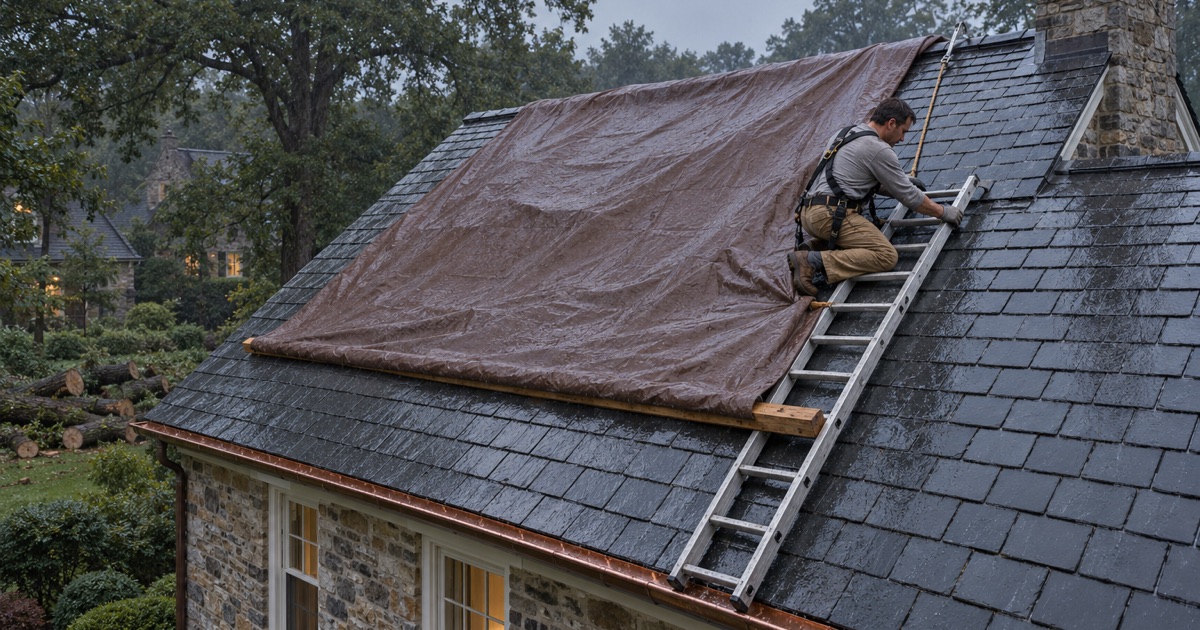
A tarp only works if wind cannot get underneath it. We run tarps over the ridge where possible and fasten them with wood strips along the edges, so they shed water downhill rather than collecting it.
We size the tarp to cover the damaged area with plenty of overlap onto sound roofing. A tarp that is too small simply moves the leak a few feet.
Quick Patches on Small Openings
For smaller damage, such as a missing pipe boot or a few lost shingles, a temporary patch may be enough to keep water out until the permanent repair is scheduled. We use materials that come off cleanly later.
We tell you plainly which repairs are temporary. A patch that was meant to last a week should not still be on the roof a year later.
Insurance and the Permanent Repair
Documentation for Your Claim
We photograph the roof damage and the water path in the attic, and write a description of what failed and why. That package goes to you to send with your own claim.
Pennsylvania’s claim rules in 31 Pa. Code 146 give insurers 10 working days to acknowledge a claim, 30 days to investigate and 15 working days to decide after proof of loss. Good documentation helps you hold the claim to that schedule.
Meeting the Adjuster
When you ask, we meet the insurance adjuster on site to show what we found. We do not negotiate the claim or interpret your policy, because under the Pennsylvania Public Adjuster Licensing Law that is the work of a licensed public adjuster.
If you want someone to negotiate for you, you can hire a public adjuster directly. Our role stays the documentation and the repair.
Pricing the Permanent Repair
Once the roof is dry, we inspect the full damage from the roof and the attic and give you a written scope with each item priced separately. You get a straight answer on whether a repair will restore the roof or whether the damage is extensive enough that replacement makes more sense.
- 20+ Years in Business
- Attic Checked on Every Leak
- Line-Item Written Scopes