Haverford Roofing has more than 20 years behind it, and roofing in East Greenwich brings us a kind of house we see less often elsewhere: one that is only a few years old. A young roof that leaks raises a question an older one does not. Is this an ordinary repair, a builder’s defect, or a sign of something larger underneath?
Our answer starts in two places at once. Every leak call includes a look in the attic as well as on the roof, so we can trace the water to the spot where it actually enters before we price anything. That matters more on a newer house, where the cause decides who should be paying for the fix.
This page walks through New Jersey’s new home warranty as it touches a roof: when the clock starts, what the first year covers, and why the long tail of that coverage is about structure rather than shingles. We are not a party to any warranty, but knowing the rules helps you decide whom to call first.
Newer Houses in East Greenwich
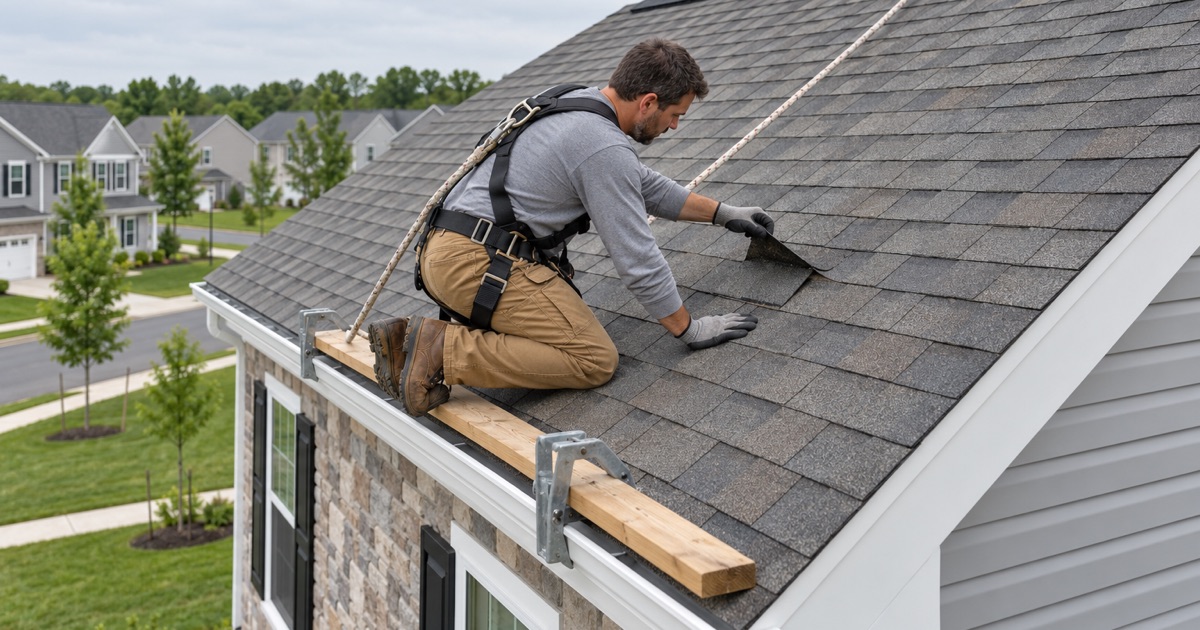
East Greenwich Township grew fast and has not stopped. The Census Bureau’s 2024 five-year survey counts 70 homes built in 2020 or later and 532 built between 2010 and 2019, on top of 1,807 from the 2000s, when the township’s 76 percent growth ranked third in New Jersey. Nearly all of it is owner-occupied single-family housing, detached or attached.
Building Since 2019 in Clarksboro
The clearest example of ongoing construction is Legacy at East Greenwich in Clarksboro, a 55-and-over Ryan Homes community that has been going up since 2019 and is listed at 140 homes. Some of those houses have had owners for several years; others are still being finished. On a street like that, two roofs built a few years apart can sit in very different places on the warranty calendar.
We should be clear about our own role. We have no connection to the builder, and we do not know which warranty plan any East Greenwich builder enrolled in. What we can do is look at the roof, find the cause, and give you a plain account you can take wherever it needs to go.
Two Age-Restricted Communities
Country Walk in Mickleton is another 55-and-over community, made up of ranch homes whose listings give a 1996 build year. Those houses are well past any warranty question. The two communities sit at opposite ends of the warranty calendar, and the right first conversation is different for each. Neither community’s rules on who maintains the roof are something we assume; we ask before we quote.
Mount Royal and the 2000s Stock
Most of the township’s houses are older than any warranty window. One detached house in Mount Royal’s Berkley Landing subdivision, built in 2001 with a pitched shingle roof, had that roof replaced in 2020. Much of the 2000s housing here has reached a similar age, and for those owners the warranty question is already settled.
For those roofs, we give a straight answer on whether a repair will hold before replacement comes up at all. When replacement is the right call, our written scope lists tear-off, decking, underlayment, flashing, ventilation and gutters as separate lines, so you can set two estimates side by side and compare them item by item.
Looking for roofing closer to Worcester? See Worcester Roofing.
When the Warranty Starts and Whom It Follows
New Jersey’s new home warranty rules, in N.J.A.C. 5:25, start the clock on what they call the warranty date. That is the date the owner first occupies the house or the settlement date, whichever comes sooner.
It is not the day the shingles went on, which may have been months earlier. Every layer of coverage counts forward from that one date.
Finding Your Own Warranty Date
The warranty date is a fact about your particular house, so it has to come from your own closing papers, not from a neighbor’s or from the year on a listing. Two houses on the same Clarksboro street can have warranty dates far apart if one sat unsold longer than the other. We never guess at it for you.
That matters for a roof because the coverage that touches shingles and flashing is short. If your settlement was a while back, the part of the warranty that speaks to roof leaks may already be behind you, even though the house still feels new. Checking the date costs nothing and frames everything else.
Buying a Nearly New House in Clarksboro or Mickleton
The rules define owner to include the original buyer’s successors in title. A resale buyer of a nearly new East Greenwich house therefore steps into whatever coverage remains from the original warranty date. The clock does not restart at your own closing, and it does not stop while the house changes hands. Buyers who purchase to resell or rent out are excluded from that definition.
If you are buying in Clarksboro or Mickleton and the house is only a few years old, it is worth knowing where the roof sits on that calendar before you settle. We can inspect the attic and the roof surface, note any lifted shingles, stains or ventilation problems, and put what we find in writing.
The First Year: Leaks, Lifted Shingles and Attic Ventilation
Under the warranty’s one-year layer, the house is to be free of performance standard defects, and the roof items sit there. N.J.A.C. 5:25-3.5 treats a roof or flashing leak that occurs under normal weather conditions as a deficiency, and the builder’s job is to correct leaks verified to have happened that way. The word verified does real work in that sentence.
We can help you document it. We trace the water from inside the attic to the point on the roof where it gets in, and we note the weather it came with, so the record shows whether the leak happened in an ordinary rain.
Shingles That Lift or Curl
Shingles that lift or curl during the first year of coverage, or tear loose in normal weather, are also listed as a deficiency, and the remedy is to repair or replace them. On a new roof that often points to how the shingles were fastened or sealed rather than to the material itself. We photograph what we see so the pattern is on record.
A curled shingle in the second or third year is a different matter. The regulation ties lifting and curling to the first year of coverage, so after that point we treat it as a repair question, and we tell you whether a repair will hold or whether the problem is spreading across the slope.
Attic Ventilation as Its Own Item
Insufficient attic ventilation is a separate first-year item, and the regulation’s fix is to install properly sized louvers or vents. This is where our habit of checking the attic on every call earns its keep. Frost on the underside of the decking, damp insulation or a musty smell can look like a roof leak from below when the real cause is trapped moisture.
Telling the two apart matters on a young house. A ventilation shortfall and a flashing leak are different items with different fixes, and a report that mixes them up helps nobody. We check the intake vents low on the roof and the exhaust vents up high, not just the wet spot itself.
Storms Are Excluded
The same roofing provision excludes leaks caused by severe weather: ice and snow build-up, high winds and driven rains. East Greenwich knows what high wind can do. On June 23, 2015, a macroburst with estimated winds of 85 mph hit the township, and the National Weather Service called it the hardest-hit part of Gloucester County.
East Greenwich falls in the National Weather Service’s Gloucester forecast zone, NJZ017, served by the Mount Holly office. When a leak shows up after a storm, the date and the warnings issued for that zone help show whether the weather was ordinary or severe. We note both in our write-up.
Damage from a storm like that falls outside the builder’s warranty and is a question for your homeowners policy. We photograph storm damage and write it up for your own claim, and we will meet the adjuster on site when asked, though the claim itself stays between you and your insurer.
Years Two to Ten: Structure, Not Shingles
After the first year, the warranty narrows quickly. The two-year layer covers mechanical and electrical systems and major structural defects, and from then through year ten only major structural defects remain. Nothing in those later layers mentions shingles, flashing or roof leaks. Owners who hear the phrase ten-year warranty often assume otherwise.
What Counts as a Major Structural Defect
The rules define a major structural defect as actual damage to the load-bearing portion of the home that affects its load-bearing function and vitally affects, or is imminently likely to vitally affect, its use as a residence. A worn shingle or a dripping pipe boot does not meet that bar. A sagging roof plane caused by failed framing might.
So in years two through ten, a roof problem on a newer East Greenwich house is usually an ordinary repair. Rafters, trusses and the walls carrying them are the load-bearing parts; the covering on top is not. If we find damage that looks structural, we stop, photograph it and tell you before any work goes further.
Decking and Flashing on a Young Roof
Decking sits between the two worlds. It is part of the roof assembly, and on a newer house damaged sheets usually trace back to a leak, not to the frame. When we open a roof and find soft decking, we photograph it and show you before replacing it, at a per-sheet price already set in the contract.
Flashing is the other part we treat carefully. When a roof is replaced, we replace the step, counter and chimney flashing with it rather than reusing old metal under new shingles. We also size and pitch gutters and downspouts along with the roof, since water leaving the eaves has to go somewhere.
Our Order of Steps on a Young House
On a house in its first year, the order of our steps matters: trace the water, separate a normal-weather leak from storm damage, and give you a written account before anything is repaired. That way you decide what happens next with the facts in hand. Each work day ends with the driveway, yard and gutters cleaned and a magnet sweep for nails.
- 20+ Years in Business
- Attic Checked on Every Leak
- Line-Item Written Scopes