
Haverford Roofing specializes in chimney flashing repair in Haverford, PA, serving surrounding cities including Uwchlan, Yeadon, West Bradford, Upper Providence Township, Nether Providence. On the older stone and brick houses we have worked on for 20+ years, the chimney is the single most common source of roof leaks, and most of those leaks come from flashing that was patched rather than rebuilt.
We start every chimney leak call in the attic. Water running down the chimney chase or along the rafters beside it shows which side is failing, and whether the water is coming through the flashing or through the masonry itself.
Then we tell you plainly what the fix is. Most chimney leaks are a flashing repair, not a reason to replace the roof, and the scope lists each piece of flashing we will replace and how it will be installed.
How Chimney Flashing Works
Step Flashing Along the Sides
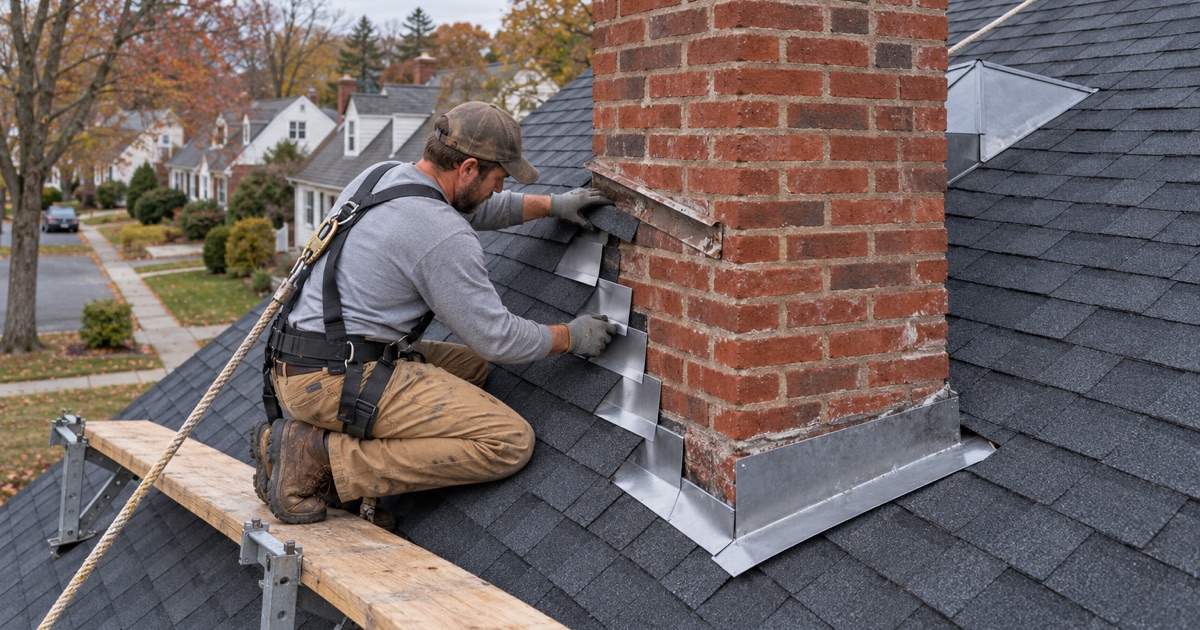
Along each side of the chimney, individual L-shaped pieces of metal are woven in with every course of shingles or slate. Each piece laps over the one below, so water running down the side is carried back onto the roof surface.
When a roofer instead runs one long piece of metal down the side, or skips pieces, water gets behind it. We install a separate step flashing piece with every course, the way it is meant to be done.
Counter Flashing Set Into the Mortar
Counter flashing covers the top of the step flashing and keeps water from running behind it. The right way to install it is to cut a reglet, a groove, into a mortar joint, fold the top edge of the metal into it, and seal it there.
Surface-mounted counter flashing held on with caulk and a few nails pulls away as the caulk ages. We cut a proper reglet and set new counter flashing into the masonry so it stays tight for the life of the roof.
Front Apron and Back Pan
On the downhill side of the chimney, an apron flashing carries water over the shingles below. On the uphill side, a back pan or cricket keeps water from pooling where the roof meets the brick.
The uphill side takes the most water, especially on a wide chimney, and it is where we see most leaks. We rebuild that area first if it has failed.
Crickets on Wide Chimneys
A cricket, also called a saddle, is a small peaked roof built behind the chimney. It splits water and debris to either side, so nothing piles up against the masonry.
Wide chimneys without a cricket hold leaves, snow and ice against the brick, and the flashing there fails early. We frame and flash a cricket when the chimney is wide enough to need one, and include it in the scope as its own line.
Signs Your Chimney Flashing Is Failing
Stains Beside the Chimney
Water stains on the ceiling or wall next to the chimney, damp plaster or peeling paint near the fireplace, and dark wood beside the chimney in the attic all point to a leak at or near the flashing.
We trace the stains from the attic to the side of the chimney where water is entering. That tells us whether one side or the whole set needs replacing.
Loose, Rusted or Caulked Metal
From the roof, failed flashing shows as counter flashing pulled away from the brick, rusted or holed metal, or thick layers of caulk and roofing tar smeared over the joints. Heavy tar usually means someone has patched the same leak more than once.
We remove the old patches and the failed metal entirely. Laying new flashing over old tar traps moisture and leaves an uneven surface that never seals properly.
Leaks That Come Through the Masonry
Not every chimney leak is a flashing problem. Cracked crowns, missing mortar and porous brick above the roof line let water soak into the chimney and run down inside it.
We look at the masonry while we are up there and photograph anything that needs a mason. Replacing flashing will not stop water that is entering through the brick above it.
Chimney Flashing on Older Main Line Roofs
Slate Roofs and Copper Flashing
Many slate roofs here have copper or lead-coated flashing at their chimneys. When it fails, we replace it with copper and rebuild the slate around it, fastening each slate with copper nails or slate hooks.
We avoid mixing aluminum or galvanized steel into a copper flashing detail. Dissimilar metals corrode where they touch, and the repair fails early.
Flashing Replaced With a New Roof
When a roof is replaced, we replace the step, counter and chimney flashing with it rather than reusing the old metal. Old flashing has been bent, nailed and sealed too many times to sit tight under new roofing.
That is listed as its own item on the replacement scope, so you can see it is included and compare it against other estimates. An estimate that does not mention chimney flashing usually means the old metal is staying.
Historic Resource Houses
In Haverford Township, removing or covering any part of a historic resource’s roof is listed as demolition under Section 182-1302. We check the Historic Resource Inventory before scheduling flashing work that involves taking off part of the roof.
Where a house is listed, we keep materials like-for-like and confirm with the township whether the work needs review, so the repair does not turn into a stop-work order. Copper replaced with copper is usually the simplest path through that process.
Materials and Special Cases
Choosing the Flashing Metal
Aluminum is common on asphalt roofs and is easy to form, while copper lasts far longer and belongs on slate roofs and on houses that already carry copper elsewhere. Lead-coated copper is used where a duller finish suits older masonry.
We match the flashing metal to the roof and to the gutters and valleys already on the house, and we name the metal in the scope so you know exactly what is going on your chimney.
Chimneys Near Valleys and Dormers
Some chimneys sit in or right beside a valley, or tight against a dormer wall, where water arrives from two directions at once. Standard flashing details have to be adapted, and these are the chimneys most often patched badly.
We work out how water will move around the chimney before cutting any metal, adding a cricket or extending the valley lining so nothing is directed straight into the joint.
- 20+ Years in Business
- Attic Checked on Every Leak
- Line-Item Written Scopes