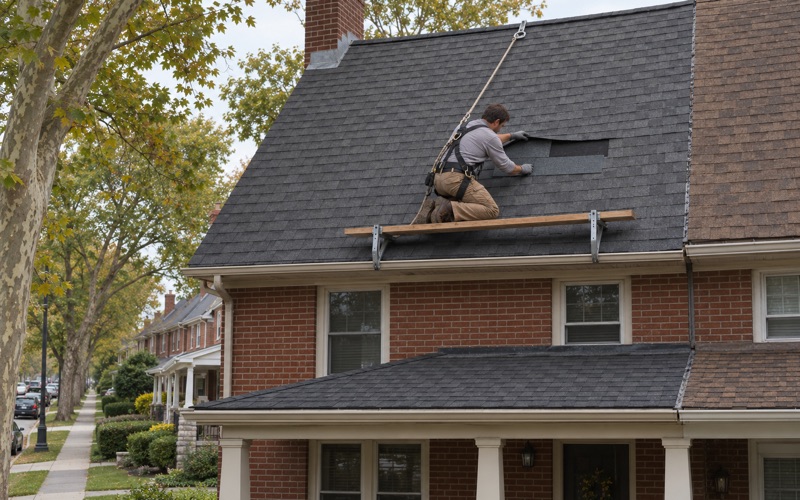
Haverford Roofing has spent more than 20 years on roofing in Bryn Mawr and the townships around our home base, and most of the calls we take here start the same way: a stain on a ceiling and an owner who wants to know what it means. We answer that with a look in the attic as well as on the roof. The water gets traced to the spot where it actually enters before anything gets a price.
That order matters on older houses, where a drip in a back bedroom can begin at a chimney, a valley or a gutter several feet away. Once we know the source, you get a straight answer on whether the roof can be repaired. Replacement only comes up when repair is honestly off the table.
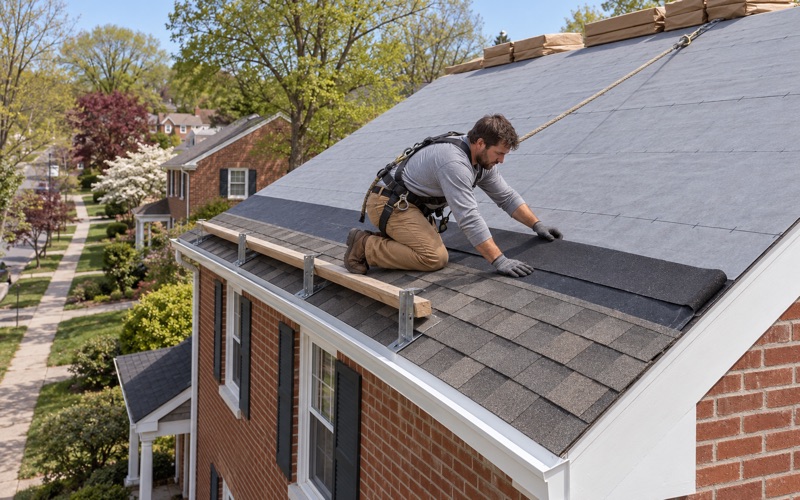
When a full job is the right call, our written scope breaks out tear-off, decking, underlayment, flashing, ventilation and gutters line by line. That lets you set our number beside anyone else’s and compare item by item. It also means nothing about the work is left to a handshake.
A Village Built Around a National Register Campus
Bryn Mawr was called Humphreysville until the Pennsylvania Railroad’s Main Line arrived in 1869, and Bryn Mawr College followed in 1885. Today the village is a census-designated place of under a square mile, strung along Lancaster Avenue just west of Philadelphia. Its stock of old buildings is the first thing that shapes a roof job here.
The Bryn Mawr College Historic District
The campus was listed on the National Register in 1979 as the Bryn Mawr College Historic District. The nomination runs from Ely House, dated 1776, and Wyndham, from 1796, through Addison Hutton’s Taylor Hall to a set of stone Collegiate Gothic halls by Cope and Stewardson built between 1886 and 1904.
Radnor, Denbigh, Dalton and Pembroke halls belong to that group, along with Rockefeller Hall and the Thomas Library, which also carries its own National Register listing. Photographs filed with that listing show crenellated stone parapets and towers on the front and a stone gable with a pitched roof on the west wing.
From Collegiate Gothic to Louis Kahn
The district does not stop at the turn of the century. Louis Kahn’s Erdman Hall, built from 1963 to 1965, is described in the nomination as a modern take on Collegiate Gothic: a cement building sheathed in gray slate. Canaday Library and Haffner Hall followed around 1970.
For a homeowner a few blocks away, the point is not the architecture lesson. It is that the village grew up beside buildings of stone and heavy masonry, and a large share of the houses around them is nearly as old. Those materials set the terms for gutters, flashing and leak repair.
Which Township Governs Your Roof
Bryn Mawr is not a municipality, so code, permits and historic review belong to whichever township a property sits in. Since the 2020 census the village takes in sections of Lower Merion Township in Montgomery County plus portions of Radnor and Haverford townships in Delaware County.
Each of those townships sets its own re-roof rule, so we confirm the one for your address before we price the job. On the Lower Merion side, a roof permit addendum accompanies every roofing application and caps shingle roofs at two layers. Lower Merion properties on the township’s historic inventory, outside its local districts, go to the Historical Commission.
On the Haverford Township side, we check the Historic Resource Inventory before scheduling, because removing or covering part of a listed resource’s roof goes to the township for review. Radnor adopted the 2018 International Existing Building Code for repairs and alterations, and we confirm its current roof requirements directly before quoting.
Looking for roofing closer to Caln? See Roofing Services in Caln.
What the College’s Own Roof Work Shows
We had no part in any campus project, but the firms behind two of them have published accounts that are worth a homeowner’s attention. They show what an old masonry building asks of a roof, and the same demands turn up on a smaller scale on Bryn Mawr’s prewar houses.
Rockefeller Hall: Gutters and Localized Waterproofing
At Rockefeller Hall, a Cope and Stewardson building the college treats as a landmark, Kurtz Construction took on a 2019 job with a clear brief. The building had to be completely watertight while still preserving the historical characteristics of the original building. The crew repaired the gutters and waterproofed localized areas with a liquid-applied Sika Sarnafil system.
Notice what the job was not. The project account describes gutter repair and localized waterproofing on a historic building, not a new roof. That is the same instinct we bring to an old house: find where water actually gets in and fix that before anyone talks about replacement.
Erdman Hall: Slate Panels Taken Down and Re-Anchored
Erdman Hall’s roof rehabilitation went another way. The engineering firm CVM evaluated the condition of the original slate panels that comprised the roof, worked out how to take them down temporarily, and designed a new anchorage system to hold them in place once restored. The published account does not give a year for that work.
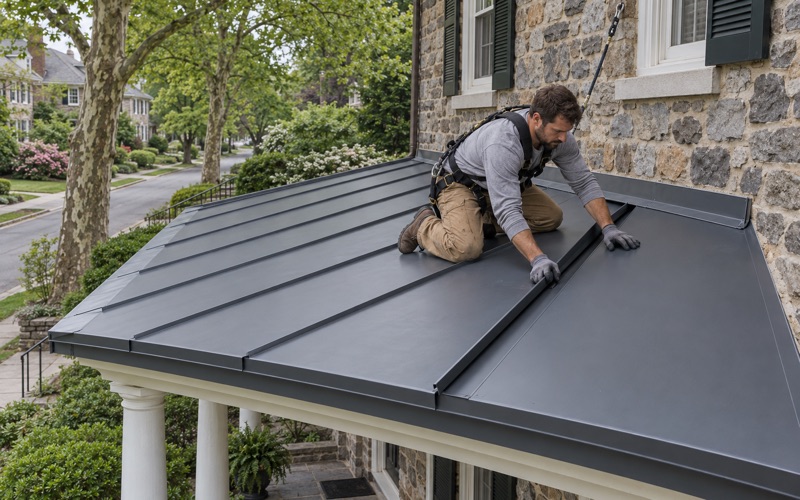
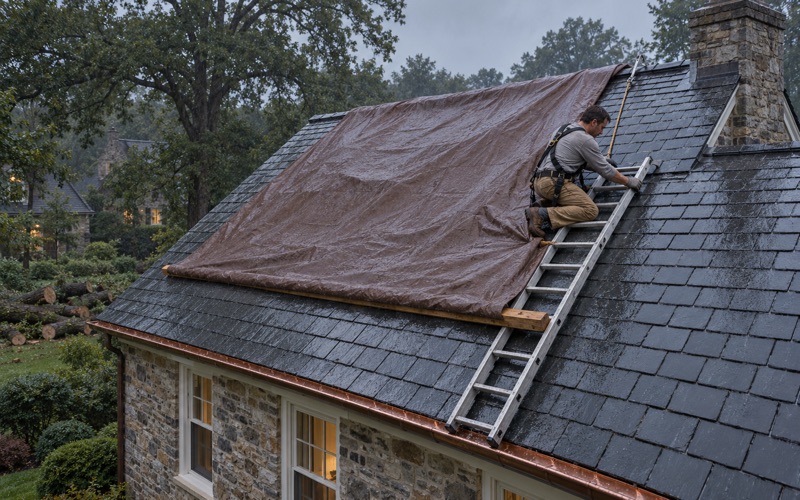
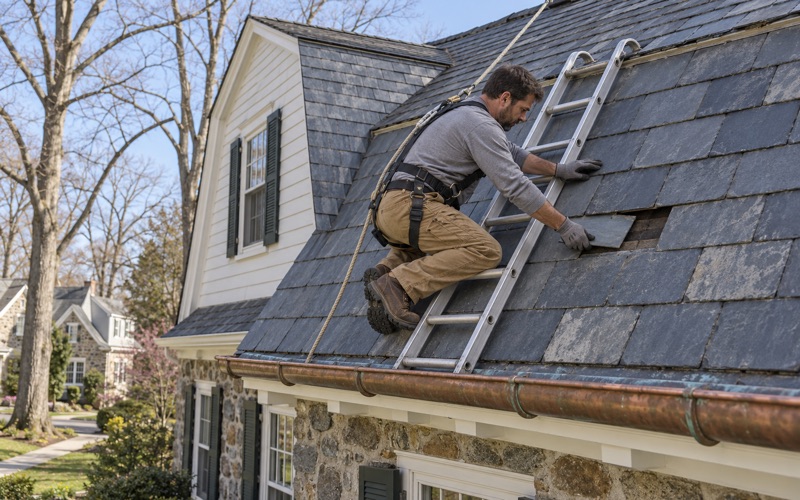
The lesson for a slate house is that sound slate is worth keeping, and the fastening is often what fails before the stone does. We repair slate roofs slate by slate with copper nails and slate hooks. Tearing off a sound slate roof is never our opening suggestion.
What These Jobs Mean for a Private Roof
Neither project tells you what any particular house needs, and we never assume the college’s choices fit a twin on a side street. What they do show is a sequence: inspect closely, decide what can stay, and repair what is failing. Our leak calls follow that order, from the inside out.
When a replacement does go ahead, damaged decking found under the old roof is photographed and shown to you before it is replaced. The per-sheet price is already set in the contract, so an old house’s hidden surprises do not turn into an open-ended bill.
Gutters and Waterproofing on Old Stone Buildings
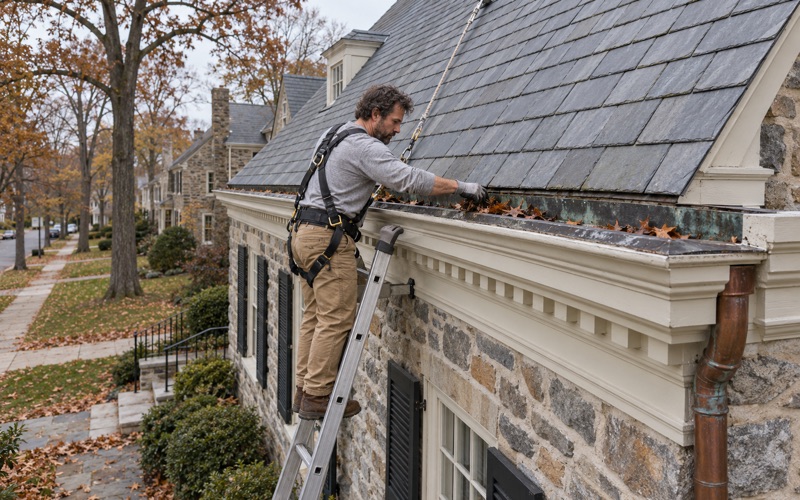
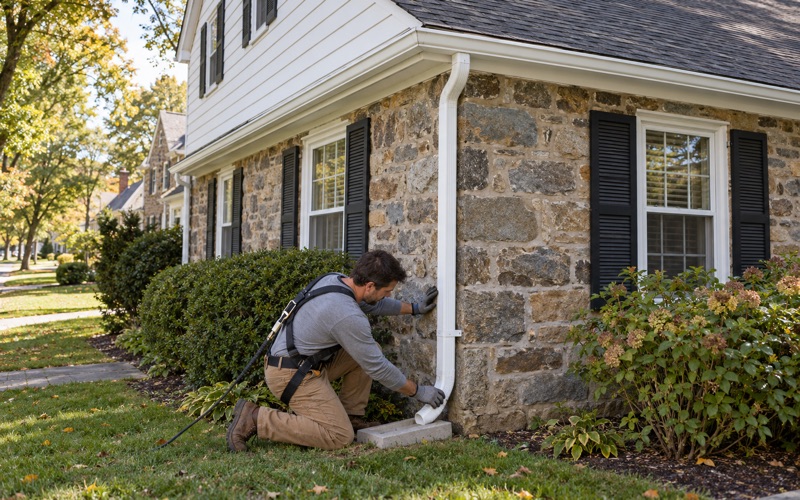
The Rockefeller Hall job put gutters at the center of keeping a historic building dry, and that holds on Bryn Mawr’s older houses too. On a masonry wall, water that overshoots or backs up out of a gutter does not just drip; it soaks into stone and mortar and finds its way inside.
Gutters Sized and Pitched With the Roof
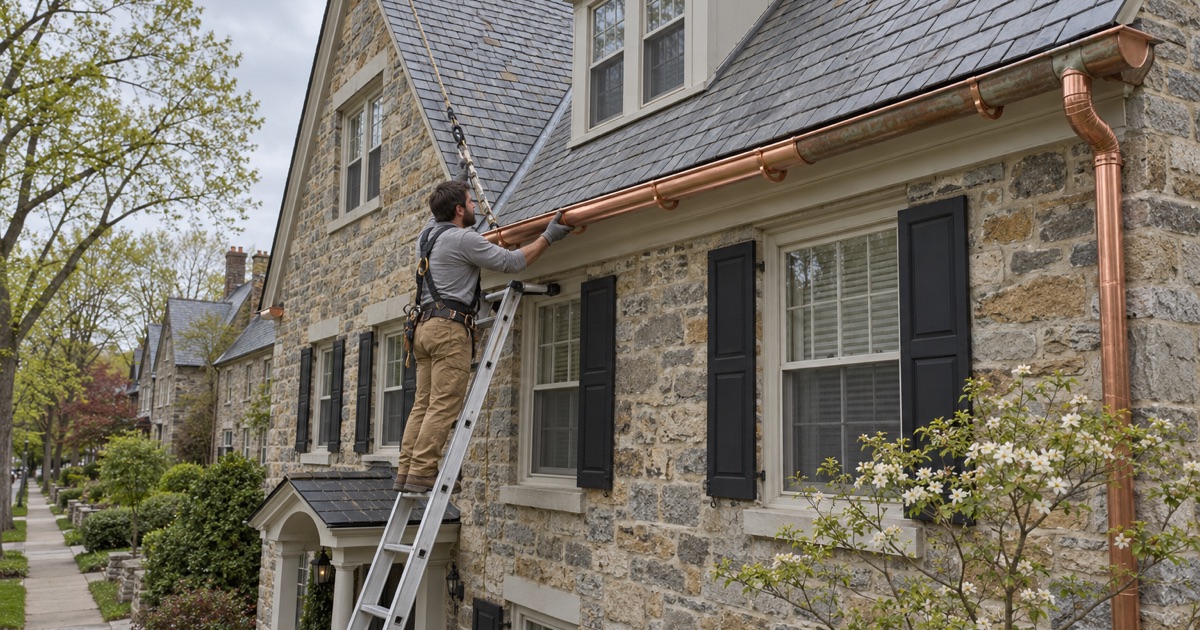
We size and pitch gutters and downspouts as part of the roof plan, not as an add-on at the end. On older houses that can mean seamless aluminum gutters on a rebuilt fascia, or half-round copper gutters where a slate roof calls for them.
Downspouts need somewhere to send the water once it reaches the ground. A gutter that is the right size but discharges against a stone foundation only moves the problem. We look at where each outlet lands before we settle the layout.
Box Gutters on Older Houses
Some prewar houses carry box gutters, built into the roof edge rather than hung from it. When the lining of a built-in gutter fails, water runs into the cornice and the wall below, often well away from where the stain shows up indoors.
We trace those leaks from the attic and the eave before deciding whether the box needs a new lining or a different fix. Painted trim and fascia on a pre-1978 house are handled under the EPA RRP lead-safe rule whenever the work disturbs them.
Flashing Where Roof Meets Masonry
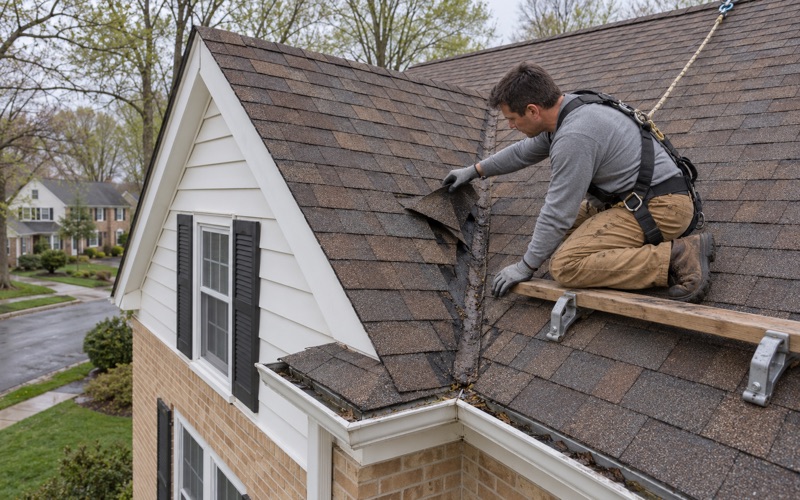
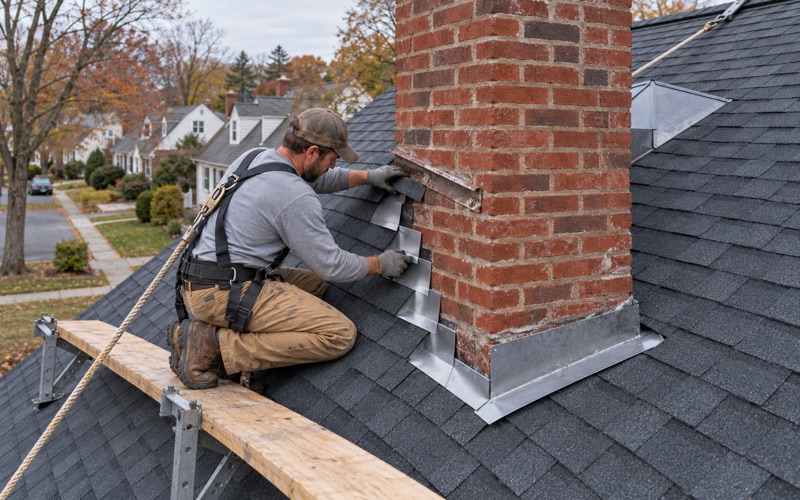
Chimneys, parapets and stone gables are common places for old roofs to let water in. We replace step, counter and chimney flashing along with the roof rather than reusing it under new material, and counter flashing is set into a reglet cut into the masonry where the wall allows.
A wide chimney on the upslope side gets a cricket, or saddle, so water splits around it instead of pooling against the brick. Kick-out flashing where a roof edge meets a sidewall keeps runoff out of the siding or stone below.
Rented Prewar Housing and Who Orders the Roof Work
Bryn Mawr’s houses are old and mostly rented. Census figures count 810 of the village’s 2,122 housing units, or 38.2%, as built in 1939 or earlier, and renters occupy 1,005 of the 1,865 occupied homes, or 53.9%. That mix changes who calls us and what they need.
Twins and Attached Houses
Close to a third of Bryn Mawr’s housing, 664 units, is single-family attached, and most of the rest is in small and large apartment buildings rather than detached houses. On a twin or row, one roof often runs straight across to the neighbor’s with only a party wall between them.
We plan those jobs with the neighboring roof and the shared wall in mind. The tie-in at the property line, the flashing over the party wall and the drainage that crosses it are all settled before work starts, so a new roof on your half does not create a leak on the other.
Landlords, Tenants and Access
With more than half of occupied homes rented, the person who notices a leak is often not the person who pays for the repair. Tenants call owners, owners call us, and a lot of time can pass in between while water keeps coming in.
For rental owners who live elsewhere, the itemized scope lets a decision be made line by line without guesswork. Contracts follow Pennsylvania’s home improvement law, including the three-business-day cancellation notice and a deposit kept within the legal limit.
Prewar Houses and Apartment Buildings
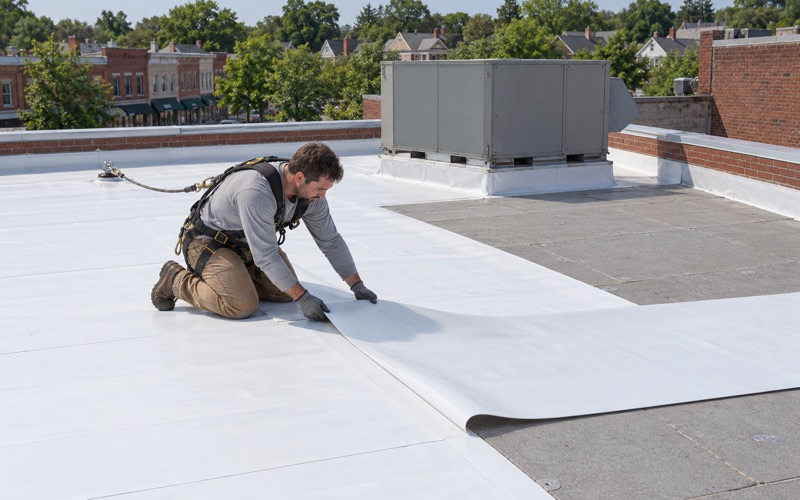
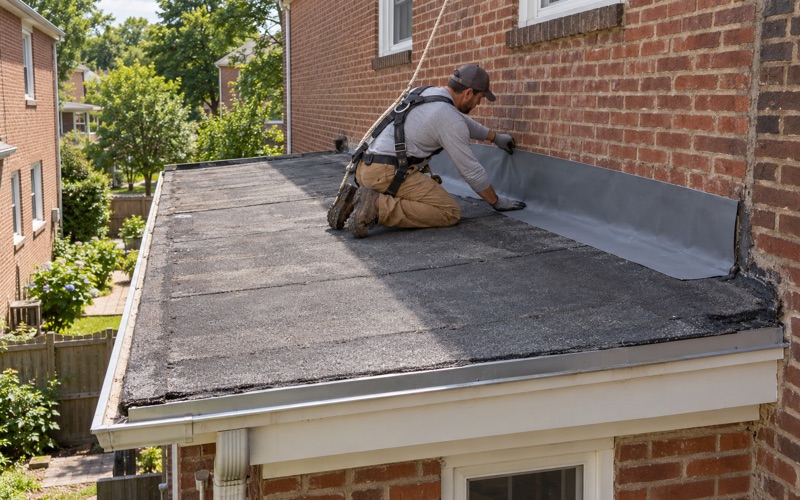
Bryn Mawr’s housing does not stop at houses. The village counts 377 units in buildings of 50 or more and another 125 in buildings of 20 to 49, and larger buildings often carry low-slope roofs. We work with EPDM, TPO and modified bitumen on flat and low-slope sections.
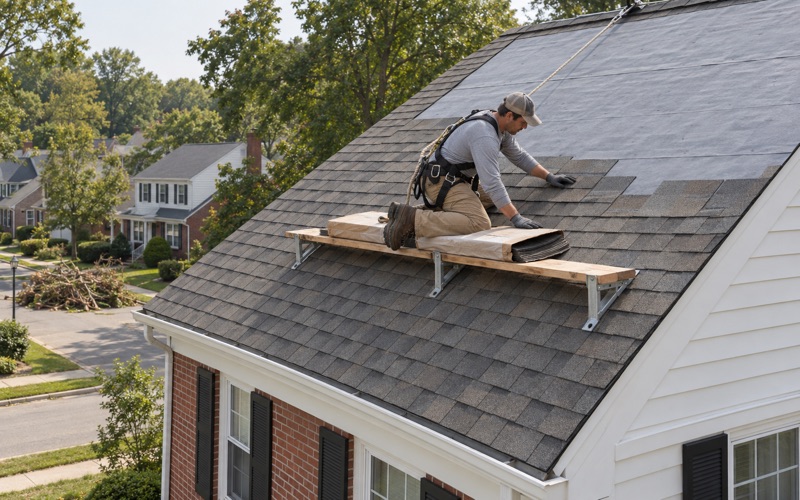
On the older detached and attached houses, slopes and materials vary widely. Where shingles are the right choice we use architectural shingles over a self-adhering ice barrier at the eaves, with ridge venting balanced against soffit intake. At the end of every work day we clean the driveway, yard and gutters and run a magnet sweep for nails.
Storm Claims and the Adjuster
After a wind or hail storm, we photograph the damage and write it up so the owner has a record for their own claim. When asked, our crew will meet the insurance adjuster on site to walk the roof together.
We do not negotiate the claim; that stays between the owner and the insurer. On a rental, the write-up goes to whoever holds the policy, which keeps tenants out of a dispute they have no part in.
- 20+ Years in Business
- Attic Checked on Every Leak
- Line-Item Written Scopes